
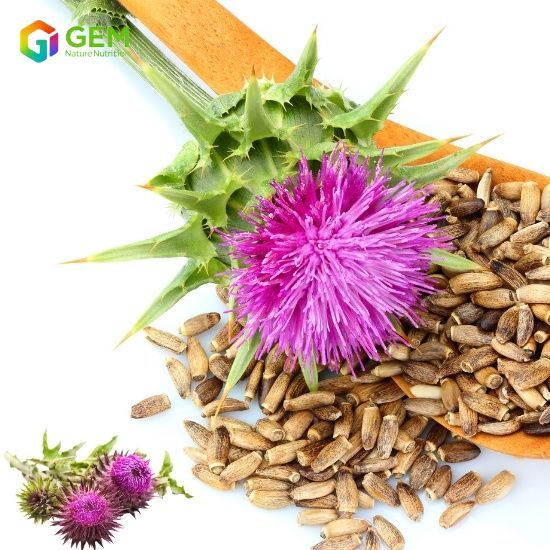
Milk Thistle Extract
Milk Thistle Extract bulk ingredient for B2B formulation sourcing. Request a specification sheet, batch COA, and documentation from GEM.
| 规格名称 | 规格值 |
|---|---|
| Part Used | Milk thistle seed |
| Latin Name | Silybum marianum (L.) Gaertn. |
| Solvents | Acetone; Ethyl Acetate; Ethanol. |
| Shelf Life | 24 months |
| Stock | Have storage in EU warehouse |
Milk Thistle Extract
Milk Thistle Extract is a standardized botanical ingredient from Silybum marianum seed, rich in the flavonolignan complex Silymarin. GEM supplies acetone, ethyl acetate, and ethanol extraction grades for global B2B supplement, pharmaceutical, and functional food customers.
Milk Thistle Extract Quick View
Specification: Silymarin 80% UV with Silybins > 30% Silymarin > 50% by HPLC Silybin > 95%
Mesh: 80mesh
Certificate: ISO22000; ISO14001; ISO9001; FSSC22000; GMP; Kosher; Halal
Annual Production Capacity: More than 300 tons
Features: Fine powder; Non-GMO; Non-ETO; Non- Radiation; USP&EP Standard; Allergen (soy, gluten) free;
Application: Pharmaceutical and medicine; Dietary supplement; Basic nutritional ingredients; Food and beverages; Food additives and Cosmetics; Feed and pet ingredients. etc.
Packing: 25 kg/drum, 2 layers PE bags inside.
Last updated: June 21, 2026
What Is Milk Thistle Extract?
Milk thistle (Silybum marianum (L.) Gaertn.) is a traditional herbal plant that has been used in China for thousands of years. It is widely cultivated in Inner Mongolia, Northeast China and other suitable growing regions. We select high-quality milk thistle seeds to produce premium extracts rich in Silymarin.
What is Silymarin?
1. Silibinin (Silybin A & B): The most abundant and biologically active component.
2. Isosilibinin: Crucial for supporting metabolic pathways.
4. Silychristin: Works synergistically to support cellular repair.
Milk Thistle Extract Specification
| Test Item | Specification | Test Methods |
|---|---|---|
| Appearance | Yellow to light brown powder | Visual |
| Silymarin(UV) | ≥80% | UV |
| Silymarin(HPLC) | ≥45% | HPLC |
| Sum of silybin and isosilybin | ≥30% | HPLC |
| Particle Size | ≥95% pass 80 mesh | Screen |
| Bulk density | Test value g/ml | Powder characteristic tester |
| Tap density | Test value g/ml | Powder characteristic tester |
| Loss On Drying | ≤5% | 5g/105°C/2hrs |
| Sulphated Ash | ≤0.6% | 2g/800°C/4hrs |
| Acetone Residues | ≤5000 mg/kg | Gas Chromatography |
| Lead | ≤1mg/kg | ICP-MS |
| Arsenic | ≤1mg/kg | ICP-MS |
| Mercury | ≤0.1mg/kg | ICP-MS |
| Cadmium | ≤1mg/kg | ICP-MS |
| Total Plate Count | ≤1000CFU/g | Plate counting |
| Total Yeast&Mold | ≤100CFU/g | Plate counting |
| Coli Group | ≤3.0MPN/g | Counting MPN method |
Remark: Above spec is only for silymarin 80%UV silymarin &30%HPLC silybins by acetone. If you have any special request for quality, please send us email and we can check it for you accordingly.
Production Process
Milk thistle seeds→Oil expression→Extraction(adding solvents)→Concentration→Degreasing(adding hexane)→Dring→Crushing→Sieving&Mixing→Packing→Finished products.
What's the Difference Between Different Solvents for Milk Thistle Seeds Extract?
Choosing the Right Milk Thistle Extract: Solvent & Specification Guide
In the global production of Silymarin, the choice of extraction solvent is the most critical factor affecting both the purity and the price of the final product. Based on current market trends and exporting data from major Chinese factories, here is a breakdown of the three primary extraction methods.
1. Extraction Solvents: Price vs. Popularity
Not all extracts are created equal. The solvent used determines the final price and application.
| Solvent Type | Price Rank (If same spec) | Market Position | Best For... |
|---|---|---|---|
| Acetone | Lowest | Best Seller | High-volume industrial & pharma use. |
| Ethyl Acetate | Middle | Rank Third | Who seeking specific purity profiles. |
| Ethanol | High | Rank Second | High-End/Natural/Organic field. |
Market Insight: Acetone-extracted milk thistle remains the global best-seller due to its excellent balance of high yield and cost-effectiveness. However, Ethanol extraction is seeing a rapid increase in demand from premium health supplement brands.
2. Popular Industry Specifications
- Silymarin 80% UV / 30% HPLC: Best seller specification in the market.
- Silymarin 80%UV/50% HPLC: A higher purity grade preferred for pharmaceutical-grade applications.
- High Silybin Content(like silybin95%, 98%, 99%HPLC): Custom extracts where the sum of Silybin + Isosilybin is maximized for superior bioavailability.
3. Which Extract Should You Choose?
Your choice should depend on your target market's regulatory requirements and consumer preferences:
- For Competitive Pricing: Choose Acetone extraction. It offers the highest volume for the lowest cost while maintaining an 80% UV specification.
- For Premium Clean-Label Brands: Choose Ethanol extraction. It is often preferred by "Natural" and "Organic" oriented brands.
Why Choose GEM Milk Thistle Extract?
1. Superior Raw Material Sourcing
Quality starts at the source. We exclusively select premium Milk Thistle seeds for extraction. Every batch of raw materials is rigorously tested according to GB Standards before entering our facility. By controlling for harmful substances at the origin, we support a final extract of unparalleled purity.
2. Low-Solvent Extraction Technology
Safety is our signature. Throughout the production process, we implement strict internal controls to minimize solvent residues. We depend on advanced techniques to ensure that our extracts are as clean as possible, maintaining the integrity of the active Silymarin complex.
3. Global Compliance: USP & EP Standards
We understand the complexities of international regulations. GEM provides tailored solutions to ensure your supply chain remains safe and reliable. We can meet or exceed USP (United States Pharmacopeia) and EP (European Pharmacopoeia) requirements for Pesticide Residues, ETO (Ethylene Oxide)-100% ETO-free processing options, Low Hexane Residue like below 10μg/g.
4. A Reliable Supply Chain Partner
By choosing GEM, you aren't just buying an ingredient; you are securing a transparent partnership. Our seed-to-extract traceability gives you the peace of mind needed to scale your brand globally.
Frequently Asked Questions
1. What is the difference between Silymarin (UV) and Silybin (HPLC) specifications?
Silymarin by UV measures the total flavonolignan complex (typically 80% grade). Silybin by HPLC quantifies the most bioactive fraction — Silibinin A & B plus Isosilibinin. The industry best-seller is Silymarin 80% UV / Silybin ≥30% HPLC.
2. Which extraction solvent should I choose?
| Solvent | Best For |
|---|---|
| Acetone | High-volume, cost-competitive industrial and pharma applications |
| Ethyl Acetate | Brands seeking specific purity profiles at mid-range pricing |
| Ethanol | Premium clean-label, natural, and organic-oriented product lines |
3. Can GEM meet USP and EP pesticide residue requirements?
Yes. GEM can meet or exceed USP and EP requirements for pesticide residues, ETO-free processing, and low hexane residue (below 10 μg/g upon request). Confirm target market specifications when requesting a quote.
4. What mesh size is standard for encapsulation?
80 mesh is the standard grade, with ≥95% passing 80 mesh. Bulk and tapped density values are available on COA and can be discussed for your encapsulation line.
5. Is EU warehouse delivery available?
Yes. GEM maintains EU warehouse storage for select SKUs, supporting faster fulfillment for European B2B customers. Confirm availability at order time.
7. What quality documents do you provide?
We provide Specification Sheet, COA, and MSDS upon request. ISO, FSSC22000, Kosher, and Halal certificates are available for qualified commercial orders.
8. What is a typical daily serving in finished products?
Industry-standard finished products typically deliver 140–420 mg of silymarin per daily serving. Final dosage must comply with regulations in your target market — GEM provides formulation guidance but does not offer medical advice.
9. How should Milk Thistle Extract be stored?
Store in a cool, dry place away from direct sunlight. Keep containers sealed. Shelf life is 24 months under recommended conditions.