
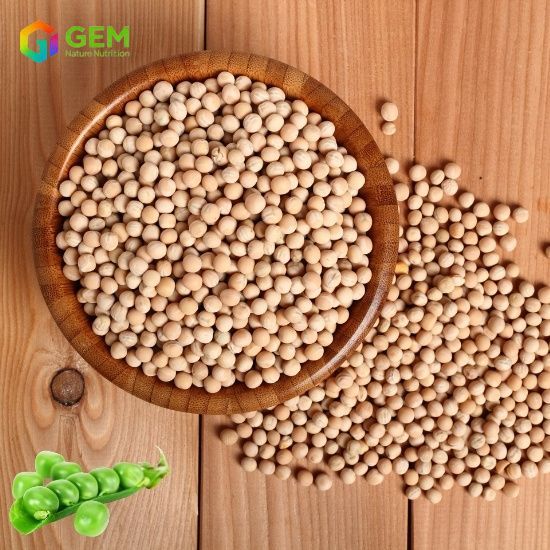
Pea protein powder
Pea protein powder bulk ingredient for B2B formulation sourcing. Request a specification sheet, batch COA, and documentation from GEM.
| 规格名称 | 规格值 |
|---|---|
| Appearance | Light yellow fine powder |
| Protein Content | 80%; 85%; 90% (food); 50%; 70% (feed) |
| Mesh | 95% pass 100 mesh |
| Shelf Life | 24 months |
| HS Code | 2106100000 |
Pea Protein Powder
Pea protein powder is a plant-based protein isolate extracted from yellow peas (Pisum sativum). GEM supplies food-grade grades at 80%, 85%, and 90% protein (dry basis) and feed-grade at 50% and 70%, with 95% passing 100 mesh, for global sports nutrition, meat alternatives, and supplement manufacturers.
Pea Protein Powder Quick View
Specification: 80%, 85%, 90% (food grade); 50%, 70% (feed grade)
Mesh: 95% pass 100 mesh
Certificate: ISO22000; ISO14001; ISO9001; FSSC22000; BRC; Kosher; Halal
Annual Production Capacity: 500+ tons
Shelf Life: 24 months
Features: Non-GMO Canadian peas; Vegan; Hypoallergenic; Low sodium option available
Application: Sports nutrition; Dietary supplements; Protein bars; Meat alternatives; Bakery; Food & beverages
Packing: 25 kg/drum, 2 layers PE bags inside
Last updated: June 21, 2026
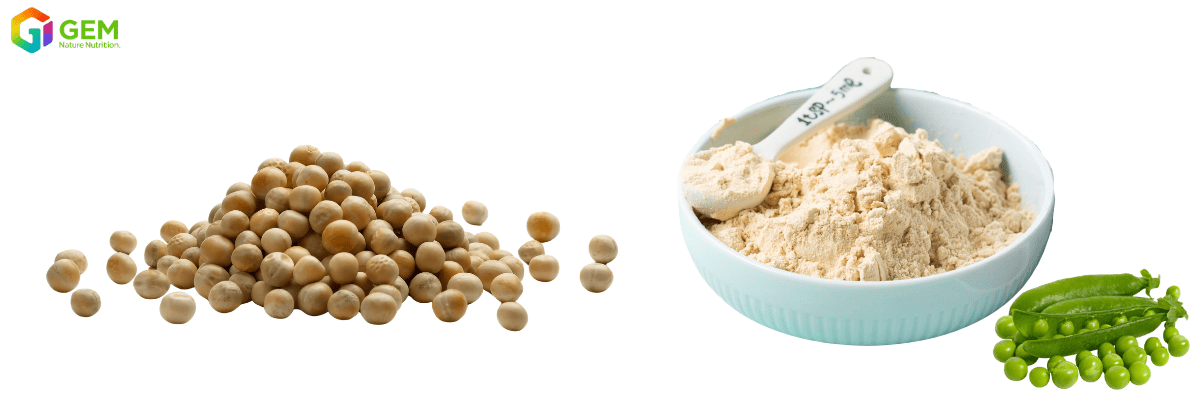
What is Pea Protein?
Sourced from superior non-GMO peas imported from Canada, our production process is based on advanced technology to extract the highest quality protein while maintaining the integrity of the raw material.
1. The Full Pea Utilization Model: Starch, Fiber, & Protein
We believe in maximizing the bioavailability and sustainability of our raw materials. By processing Canadian peas into a full suite of functional ingredients, we provide a "zero-waste" solution for the food and feed industries:
- Pea Protein (Food & Feed Grade): High-purity protein for human supplements and animal nutrition.
- Pea Protein Peptides: Smaller molecular chains for faster absorption.
- Textured Pea Protein (TPP): The perfect choice for plant-based meat alternatives.
- Pea Starch & Vermicelli: Essential for texture and traditional food manufacturing.
- Pea Fiber: Very good for digestive health applications.
2. Comprehensive Amino Acid Profile
Pea protein powder is not just for sports nutrition; it is also perfect for the general population. It contains over 18 different amino acids, providing a nearly complete profile that matches the human body's requirements. The proportion of amino acids in our pea protein is scientifically balanced to improve protein absorption rates, ensuring that your body gets the most out of every gram.
3. Canadian-Sourced Pea
The origin of the raw material defines the quality of the final extract. By importing our peas from Canada, we ensure:
- Superior Soil Quality: Resulting in higher nutrient density.
- Strict Non-GMO Standards: Meeting global regulatory demands for clean-label products.
- Neutral Taste Profile: Our peas are processed to have a low "beany" flavor, making them ideal for protein shakes, bars, and dairy alternatives.
Fermented vs. Isolated Pea Protein
Our facility has two primary processing techniques to meet diverse customer preferences. We source premium dried peas and process them according to the following standards:
- Fermented Pea Protein: Peas need to be soaked for hours during production.
- Isolated Pea Protein: Use dried peas directly to extract pea protein.
Difference: A slight taste and color difference.
Specification Data: Totally same.
Price: Totally same.
Product Specification:
| Test Item | Specification | Test Method |
|---|---|---|
| Character | Light yellow fine powder | Visible |
| Smell | Characteristic with original plant flavor | Organ |
| Mesh | 95% pass 100mesh | Sieve Machine |
| Impurity | No visible impurity | Visible |
| Moisture | ≤10% | GB 5009.3-2016 (I) |
| Protein (on dry basis) | ≥80% | GB 5009.5-2016 (I) |
| Ash | ≤8% | GB 5009.4-2016 (I) |
| PH | 6.5-8.5 | GB 5009.237-2016 |
| Melamine | Not Detected | GB/T 22388-2008 |
| Crude Fat | ≤ 10% | GB/T 5009.6-2016 |
| Aflatoxins(B1+B2+G1+ G2)(μg/kg) | < 10ppb | GB 5009.22-2016 (III) |
| Lead | ≤0.5ppm | GB/T 5009.12-2017 |
| Arsenic | ≤0.5ppm | GB/T 5009.11-2014 |
| Mercury | ≤0.1ppm | GB/T 5009.17-2014 |
| Cadmium | ≤0.5ppm | GB/T 5009.15-2014 |
| Total Plate Count | ≤10000CFU/g | GB 4789.2-2016 (I) |
| Yeast & Molds | ≤100CFU/g | GB 4789.15-2016(I) |
| Coliforms | ≤30CFU/g | GB 4789.3-2016 (II) |
| Salmonella | Not Detected/25g | GB 4789.4-2016 |
| E. Coli | Not Detected/25g | GB 4789.38-2012 (II) |
Amino acid testing data in pea protein 80%:
| Item | Results | Unit |
|---|---|---|
| Alanine | 3.05 | % |
| Aspartic acid | 8.92 | % |
| Cystine | 0.68 | % |
| Glutamic acid | 11.95 | % |
| Glycine | 3.04 | % |
| Histidine | 2.42 | % |
| Isoleucine | 3.31 | % |
| L-arginine | 6.12 | % |
| Leucine | 5.86 | % |
| Lysine | 5.6 | % |
| Methionine | 0.73 | % |
| Phenylalanine | 3.99 | % |
| Proline | 3.46 | % |
| Serine | 3.80 | % |
| Sum of amino-acids | 72.78 | % |
| Threonine | 3.00 | % |
| Tryptophan | 0.60 | % |
| Tyrosine | 2.61 | % |
| Valine | 3.64 | % |
Nutrition Data for Pea Protein Isolate 80%
| Nutritional information | /100g | Unit |
|---|---|---|
| Caloric content | 397 | kcal |
| Total Fat | 8.34 | g |
| Saturated Fat | 1.95 | g |
| Trans Fat | 0.06 | g |
| Dietary Fiber | 1.83 | g |
| Total Carbohydrate | 4.6 | g |
| Sugar | <0.1 | g |
| Protein | 81.3 | g |
| Ca(Calcium) | 166.64 | mg |
| Fe(Iron) | 22.41 | mg |
| Na(Sodium) | 881.38 | mg |
| K(Potassium) | 97.61 | mg |
| Remark: We also provide pea protein with low sodium. |
Production Process:
Raw material(peas) checking, Raw material storage,Selecting and removing impurities,Soaking, Smashing,Separation,Protein separation and purifying, Flashing sterilization,Sieving and drying, Packing, Metal detection, Finished products.
How to choose your protein content?
Selecting the correct protein content is a balance between formulation goals, cost-efficiency, and labeling requirements. While "Pea Protein 80%" is the global industry standard, higher concentrations like 85% and 90% offer specific advantages for premium products.
1. Pea Protein 80% (The Industry Standard)
- The Best-Seller: This is the most popular specification globally for food-grade applications.
- Why it's popular: It offers the best balance of high-quality plant protein and cost-effectiveness.
- Best For: General protein shakes, meal replacements, plant-based meats (TVP), and bakery products.
- Recommendation: If you are launching a new product and are unsure of the specification, 80% Pea Protein is the most reliable starting point.
2. Pea Protein 85% & 90% (Premium High-Purity)
For specialized formulations where every gram of "purity" matters, we offer concentrated grades.
- The Difference: These grades undergo additional filtration and purification steps to remove more of the natural starches and fibers, resulting in a higher protein-to-weight ratio.
- Price Point: Due to the intensive processing required to reach these levels, 85% and 90% grades are more expensive than the 80% standard.
Frequently Asked Questions
1. What protein grades does GEM offer for pea protein?
Food-grade 80%, 85%, and 90% and feed-grade 50% and 70% on dry basis. 80% is the global industry standard and our best-selling grade for new product lines.
2. What is the difference between fermented and isolated pea protein?
Both reach the same specification data and price. Fermented pea protein uses soaked peas; isolated uses dried peas directly — with slight taste and color differences.
3. Is low-sodium pea protein available?
Yes. GEM offers low-sodium pea protein upon request. Share your target sodium level when requesting a quote.
4. Which mesh size is recommended for powder blends?
95% pass 100 mesh is standard. 30 mesh powder grades are popular for general supplement manufacturing; granule grades suit capsule filling.
5. Can pea protein replace whey in sports formulas?
High-quality pea protein at 80%+ provides a complete essential amino acid profile and is widely used as a vegan, hypoallergenic whey alternative in sports nutrition. Confirm claim language with your regulatory team.
6. What quality documents are provided for B2B orders?
We provide Specification Sheet, COA, and MSDS upon request. Kosher, Halal, and ISO/FSSC certificates are available for qualified commercial orders.