
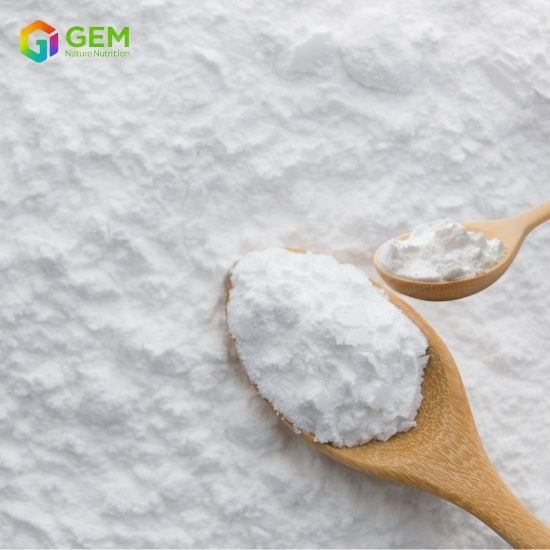
D-Ribose
D-Ribose bulk ingredient for B2B formulation sourcing. Specification: 97.0%–102% HPLC; Powder. Request a batch COA and documentation from GEM.
| 规格名称 | 规格值 |
|---|---|
| Assay | 97.0%–102% HPLC |
| Forms | Powder |
| Patents | EU & USA |
| CAS No. | 50-69-1 |
| Shelf Life | 24 months |
| Stock | Regular storage |
D-Ribose
D-Ribose is a naturally occurring five-carbon monosaccharide (CAS 50-69-1) and a structural component of ATP. GEM supplies corn-fermented, food- and pharma-grade D-Ribose powder at 97.0%–102% assay (HPLC) for sports nutrition, dietary supplements, functional foods, and pharmaceutical intermediates.
As a trusted B2B ingredient supplier, GEM delivers D-Ribose produced through a controlled microbial fermentation route that begins with corn-derived carbohydrates. Our material meets multiple international food and pharmaceutical reference standards and is supported by EU and USA patent coverage, giving qualified partners a differentiated raw material for energy, recovery, and nucleotide-related applications.
Quick View
Specification: 97.0%–102% HPLC
Available Forms: Powder
CAS No.: 50-69-1
Molecular Formula: C₅H₁₀O₅ · Molecular Weight: 150.13
Certificate: ISO22000; ISO14001; ISO9001; ISO45001; BRC; Kosher; Halal
Patents: EU & USA
Annual Production Capacity: 100+ tons
Shelf Life: 24 months
Features: Natural 5-carbon monosaccharide; Sweet taste; Water-soluble; Allergen free (soy, gluten); Pesticide free; ETO free
Application: Sports nutrition; Dietary supplements; Functional foods and beverages; Pharmaceutical intermediates; Cosmetics; Feed nutrition
Packing: 25 kg/drum
Last updated: June 21, 2026
What Is D-Ribose?
D-Ribose, also called ribose, is a 5-carbon monosaccharide naturally present in every living cell. It is a structural component of adenosine triphosphate (ATP) — the primary energy currency of cellular metabolism. The molecule has the molecular formula C₅H₁₀O₅ and a molecular weight of 150.13. In its commercial form, D-Ribose appears as white crystals or a crystalline powder with a sweet taste and high water solubility.
Ribose belongs to the chemical class of aldopentoses: a five-carbon sugar carrying an aldehyde group at the first carbon. Of its stereoisomers, only the D-enantiomer is biologically active and utilized by human metabolism; the L-form is not incorporated into natural nucleotides. Because the D-isomer is the form found in living organisms, commercial and supplemental products are specified strictly as D-Ribose.
Beyond energy metabolism, D-Ribose is the sugar backbone of ribonucleic acid (RNA) and a central building block of nucleotides. It contributes to the structure of ATP, nicotinamide adenine dinucleotide (NADH and NADPH), flavin adenine dinucleotide (FAD), and coenzyme A — molecules that together underpin redox balance, enzyme function, and cellular signaling. This broad biochemical role explains why a reliable, high-purity D-Ribose powder is valued across supplement, food, and pharmaceutical supply chains.
D-Ribose also occurs naturally in small amounts in common foods. Red meat, milk, fish, and whole grains contain trace quantities of the naturally occurring sugar. Dietary intake alone, however, is modest, which is why concentrated ribose energy supplement formats rely on purified ingredient sourcing rather than food extraction to deliver meaningful amounts per serving.
Source & Chemistry
As a pentose sugar, D-Ribose is defined by a five-carbon chain with an aldehyde functionality, making it a reducing sugar. Its three stereocenters give rise to the specific D-configuration that enzymes recognize and metabolize. In aqueous solution, D-Ribose exists partly as cyclic hemiacetal forms (furanose rings) in equilibrium with the open-chain aldehyde, a property shared with other aldoses and relevant to its reactivity, stability, and behavior during formulation and storage.
The most important context for D-Ribose is its relationship to ATP. ATP is constructed from three parts: a nitrogenous adenine base, a D-Ribose sugar unit, and a chain of three phosphate groups. The ribose moiety bridges the adenine ring to the phosphate tail; without an intact ribose skeleton, the adenine nucleotide cannot be assembled. In this sense, D-Ribose functions as the indispensable carbon scaffold of the body's primary ATP support ingredient.
Inside the body, cells generate ribose through the pentose phosphate pathway (also called the hexose monophosphate shunt). The oxidative phase of this pathway produces ribose-5-phosphate, which is then converted to 5-phosphoribosyl-1-pyrophosphate (PRPP) by PRPP synthetase. PRPP feeds both de novo nucleotide synthesis and salvage pathways that recycle adenine bases back into AMP and, ultimately, ATP. This recycling route is especially important in tissues that consume large amounts of energy on a continuous basis.
A key physiological limitation shapes D-Ribose's supplement relevance: the heart and skeletal muscles have only a limited capacity for de novo ribose synthesis. These high-demand tissues depend heavily on salvage pathways to rebuild nucleotides. When energy demand spikes — during intense exercise, or when oxygen supply is restricted — the rate of ATP breakdown can outpace the tissue's ability to resupply ribose, slowing recovery. Oral supplementation with D-Ribose may help support ATP regeneration after intense exertion (Om et al., Adv. Biosci. Biotechnol., 2013).
Specification
GEM D-Ribose is supplied against a detailed analytical specification covering identity, assay, purity, and microbiological safety. The table below lists every test item and its acceptance limit exactly as released on our certificate of analysis.
| Testing Item | Specification | Test Method |
|---|---|---|
| Description | White crystals or crystalline powder | Visual |
| Assay | 97.0%–102% | HPLC |
| Specific Rotation | −18.0° to −22.0° | AJI TEST 1 dried sample, C=4, H₂O |
| State of Solution (Transmittance) | ≥ 95.0% | AJI TEST 2 |
| Loss on Drying | ≤ 3.0% | AJI TEST 11 |
| Residue on Ignition | ≤ 0.2% | AJI TEST 13 |
| Other Saccharides | Negative | AJI TEST 9 |
| Heavy Metals (Pb) | ≤ 10 mg/kg | AJI TEST 7 |
| Arsenic (As) | ≤ 2.0 mg/kg | AJI TEST 8 |
| Total Plate Count | ≤ 100 cfu/g | AJI TEST 28 |
| Molds and Yeasts | ≤ 100 cfu/g | AJI TEST 28 |
| Salmonella | Absence/25g | AJI TEST 28 |
| E. Coli | Absence/10g | AJI TEST 28 |
| Staphylococcus aureus | Absence/10g | AJI TEST 28 |
Quality Standards: GB 1886.141-2016; EU 2017/2470; FCC 11; USP 40; AJI 97
Remark: GEM D-Ribose is protected by EU and USA patents, supporting differentiated market positioning for qualified B2B partners.
The referenced standards reflect widely recognized global benchmarks. GB 1886.141-2016 is the Chinese national food safety standard for ribose; EU 2017/2470 is the European Union's food additive modernization regulation; FCC 11 is the eleventh edition of the Food Chemicals Codex; USP 40 is the United States Pharmacopeia (40th revision); and AJI 97 represents the Japanese Amino Acid Standards. Together they give formulators confidence that the material meets consistent identity, purity, and safety expectations across major regulatory regions.
How D-Ribose Supports Cellular Energy
D-Ribose is an essential component of RNA and participates in nucleotide metabolism. It is closely linked to adenosine monophosphate (AMP) formation and ATP regeneration — one of the most fundamental energy pathways in human metabolism. Because every ATP molecule contains a ribose unit, maintaining an adequate ribose pool is a prerequisite for rebuilding depleted energy stores.
The heart and skeletal muscles have limited capacity for de novo ribose synthesis. Supplemental D-Ribose may help accelerate ATP recovery in these tissues after ischemia, hypoxia, or intense physical activity. By supplying the pentose directly, the body can bypass the slowest steps of endogenous synthesis and redirect ribose into salvage pathways that reconstitute AMP and ATP more quickly.
Application Fields
D-Ribose's clean sensory profile — a pleasant sweet taste and high water solubility — makes it especially suitable for beverage systems. In functional drinks and ready-to-mix powders, it dissolves readily and contributes mild sweetness without the caloric load of traditional sugars. For brands building plant-based nutrition platforms, D-Ribose integrates smoothly alongside Pea Protein Powder and other plant proteins to deliver a complete active-and-macro formulation in a single SKU.
Production & Quality
GEM manufactures D-Ribose through a controlled fermentation process rather than chemical synthesis from animal sources. The route begins with renewable corn-derived carbohydrates and proceeds through microbial conversion and multi-stage purification to yield a high-purity crystalline powder that meets the released specification.
Production Process
Raw materials reception (liquid glucose, corn steep liquor, yeast powder) → Fermentation → Membrane filtration → Ion exchange → Concentrating → Chromatography → Concentrating → Decolorization → Dissolving (ethanol) → Crystallization → Separation → Drying → Screening → Weighing and packing → Metal detection → Storage
Each stage is designed to remove impurities, residual saccharides, and process contaminants. Membrane filtration and ion exchange reduce ionic and colored impurities; chromatography isolates the target pentose; and crystallization plus drying deliver the specified white crystalline material. Final metal detection before storage adds a physical-safety checkpoint for bulk drums.
Quality System & Certifications
GEM D-Ribose is manufactured under a multi-certified management system, including ISO22000 (food safety), ISO9001 (quality), ISO14001 (environmental), and ISO45001 (occupational health and safety), plus BRC food certification. The product is also certified Kosher and Halal, expanding its suitability for diverse global markets. Clean-label attributes — allergen free (soy, gluten), pesticide free, and ETO free — support formulators building clean and compliant finished goods.
Capacity & Supply Security
With an annual production capacity of 100+ tons and 25 kg/drum packing, GEM supports both pilot-scale qualification and commercial-volume supply. EU and USA patent protection further reinforces a stable, differentiated sourcing position for long-term B2B partnerships that require consistency and regulatory defensibility.
Frequently Asked Questions
1. What forms of D-Ribose does GEM supply?
We currently supply powder suitable for capsules, granules, tablets, and bulk powder blends. Custom mesh grades are available upon request to match specific flow, compression, and dissolution requirements in your finished format.
2. What quality standards does GEM D-Ribose meet?
GB 1886.141-2016; EU 2017/2470; FCC 11; USP 40; AJI 97. COA, Specification Sheet, and MSDS are provided for B2B orders to support customer quality and regulatory documentation across target markets.
3. Does GEM hold patents for D-Ribose?
Yes. GEM D-Ribose is protected by EU and USA patents. Contact our sales team for patent scope and territory details relevant to your market before commercializing finished products that reference the patented material.
4. What is a typical daily serving in finished products?
Industry formulations commonly use 3–5 g per day, often split into multiple doses. Final dosage must comply with regulations in your target market and should be validated with your regulatory team and any applicable advisory limits.
5. Can D-Ribose be combined with other sports ingredients?
Yes. D-Ribose is frequently co-formulated with creatine, L-Citrulline, BCAAs, and electrolytes in sports nutrition products to support comprehensive energy and recovery profiles.
6. Which foods naturally contain D-Ribose?
Red meat, milk, fish, and whole grains contain trace amounts of naturally occurring D-Ribose. These dietary sources are minor compared with concentrated supplement formats, which is why finished products rely on purified ingredient supply.
7. How should D-Ribose be stored?
Store in a cool, dry place away from direct sunlight. Keep containers sealed. Shelf life is 24 months under recommended conditions; verify the batch-specific date on the COA for each lot received.
8. Is GEM D-Ribose suitable for vegan and vegetarian products?
Yes. Our D-Ribose is produced by microbial fermentation of corn-derived carbohydrates and contains no animal-derived raw materials. Combined with its allergen-free (soy, gluten) status, it fits vegan, vegetarian, and clean-label formulations.
9. Is the product Kosher and Halal certified?
Yes. GEM D-Ribose carries both Kosher and Halal certification, in addition to ISO and BRC food-safety credentials, supporting distribution into markets with specific dietary certification requirements.
10. What is the minimum order quantity and packing format?
D-Ribose is packed in 25 kg/drum. Minimum order quantities and lead times are confirmed with our sales team based on your formulation volume, destination, and any private-label requirements.
11. How soluble is D-Ribose in beverages?
D-Ribose is highly water-soluble and has a pleasant sweet taste, making it well suited to ready-to-drink and powdered beverage systems. Formulators should still verify clarity, sweetness contribution, and stability during pilot trials before scale-up.
12. Can D-Ribose be used in pharmaceutical intermediates?
Yes. D-Ribose serves as a starting material for nucleoside APIs, including antiviral and oncology compounds. Buyers in this segment should request the full specification, COA, and any additional documentation required for GMP-adjacent sourcing and qualification.