
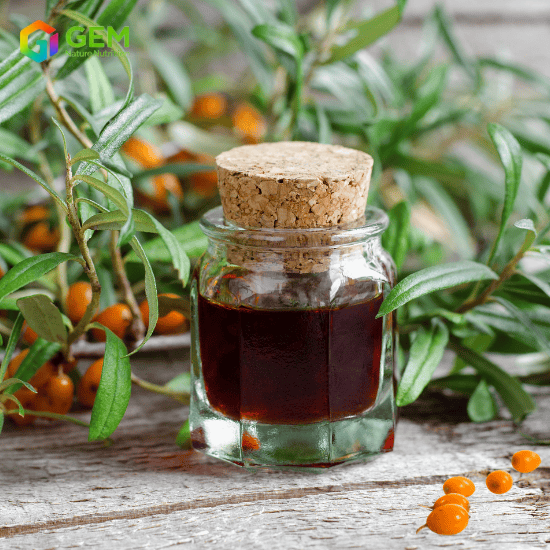
Sea Buckthorn Fruit Oil
Sea Buckthorn Fruit Oil bulk ingredient for B2B formulation sourcing. Request a specification sheet, batch COA, and documentation from GEM.
| 规格名称 | 规格值 |
|---|---|
| Omega-7 (Palmitoleic acid) | 25–35% |
| Carotenoids | ≥ 180 mg/100 g |
| Vitamin E | ≥ 100 mg/100 g |
| Appearance | Brownish red oily liquid |
| Extraction | Supercritical CO₂ |
| Shelf Life | 18 months |
| Packing | 5 kg/aluminum barrel, 4 barrels/carton |
Sea Buckthorn Fruit Oil
Sea Buckthorn Fruit Oil is a deep red-orange lipid extracted from the pulp of Hippophae rhamnoides L. berries, and GEM supplies a supercritical CO₂–extracted commercial grade standardized for Omega-7 (palmitoleic acid) 25–35%, carotenoids, and Vitamin E — a cornerstone raw material for beauty-from-within, skin wellness, and functional nutrition manufacturers worldwide.
GEM's seabuckthorn fruit oil is produced under a solvent-free supercritical CO₂ process that protects heat-sensitive carotenoids and tocopherols. Every lot is backed by ISO22000, ISO9001, HACCP, Kosher, and Halal certifications, and the facility supports an annual production capacity exceeding 100 tons, enabling stable supply for private-label softgel lines, cosmetic laboratories, and nutraceutical brands alike. This page documents the specification, sourcing, mechanism, applications, and quality workflow behind the product so procurement and R&D teams can evaluate it with confidence.
Sea Buckthorn Fruit Oil Quick View
Botanical Source: Hippophae rhamnoides L. (berry pulp)
Active Profile: Omega-7 (palmitoleic acid) 25–35%; Carotenoids ≥ 180 mg/100 g; Vitamin E ≥ 100 mg/100 g
Other Names: Sea Buckthorn Pulp Oil; Sea Buckthorn Berry Oil
Extraction Method: Supercritical CO₂
Certificate: ISO22000; ISO9001; HACCP; Kosher; Halal
Annual Production Capacity: 100+ tons
Features: Rich in Omega-7; Deep brownish red color; Natural plant oil; Suitable for oral and topical use
Application: Beauty-from-within softgels; Skin care serums and balms; Metabolic wellness formulas; Mucosal support products
Packing: 5 kg/aluminum barrel, 4 barrels/carton
Shelf Life: 18 months
Last updated: June 21, 2026
What Is Sea Buckthorn Fruit Oil?
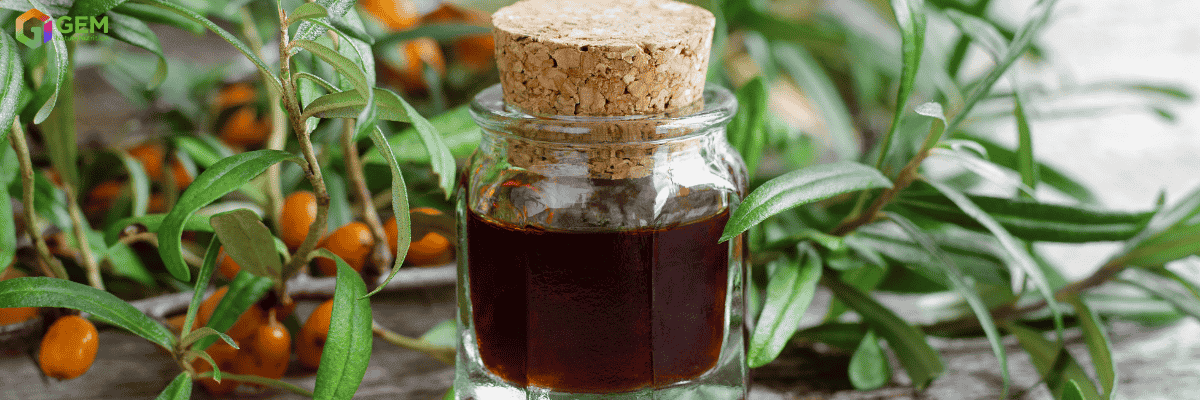
Sea buckthorn fruit oil is a precious natural lipid pressed and extracted from the pulp (the fleshy pericarp) of sea buckthorn berries rather than from the seeds. The fruit layer is where the plant stores its most distinctive actives: a dense mixture of unsaturated fatty acids, fat-soluble carotenoids, and tocopherols. In addition to unsaturated fatty acids, the fruit contains more than one hundred bioactive substances — including flavonoids, vitamins, phytosterols, trace elements, and α-tocopherol — that together shape both the oil's composition and its functional positioning.
The single most important differentiator of fruit oil versus Sea Buckthorn Seed Oil is its high Omega-7 (palmitoleic acid) content. Omega-7 is a monounsaturated fatty acid found in only a handful of plant sources; sea buckthorn pulp is among the richest natural reservoirs. Published literature reports that the pulp oil phase can be enriched up to roughly 53% palmitoleic acid under specialized processing, while GEM's commercial bulk grade is standardized to a dependable 25–35% range suited to consistent formula design.
GEM's fruit oil is recovered through supercritical CO₂ extraction, a low-temperature, solvent-free method that preserves the carotenoids responsible for the characteristic deep red-orange color. Because the process avoids harsh heat and organic solvents, the finished oil retains its natural tocopherol and pigment profile. It has become a leading ingredient in the "beauty from within" supplement category and in topical formulations that target skin hydration and barrier function, and it pairs naturally with other plant-derived actives such as Hemp Seed Oil in multifunctional blends.
For brand owners, the appeal of Sea Buckthorn Fruit Oil is not only its composition but also its story: a naturally pigmented, plant-sourced oil with a recognizable "inner beauty" narrative. That narrative is reinforced by the oil's dual usability — the same bulk lot can become an ingestible softgel and a topical serum — which simplifies sourcing and documentation for companies building coordinated product lines.
Source & Botany
Sea buckthorn is the common name for Hippophae rhamnoides L., a hardy, nitrogen-fixing deciduous shrub in the Elaeagnaceae family. The plant is remarkable for its ability to thrive on poor, sandy, and high-altitude soils where few crops survive, which is one reason it has been cultivated across a broad belt from the Himalayan foothills through Central Asia, Mongolia, Russia, and into Northern Europe. The shrub produces dense clusters of small, bright orange to red berries — the sea buckthorn berry — that are exceptionally rich in oil within both the pulp and the seed.
Botanically, the berry is a false drupe: a soft, pulpy outer layer surrounds a single hard seed. The two tissues differ sharply in chemistry. The pulp yields the fruit oil described on this page, characterized by Omega-7 and carotenoids. The seed yields a separate oil dominated by Omega-3 (alpha-linolenic acid) and Omega-6 (linoleic acid), which is why manufacturers often source both fractions. For formulators building a complete sea buckthorn portfolio, pairing the two oils delivers broad Omega-3/6/7 coverage from a single botanical genus.
From a sourcing perspective, berry maturity and harvest timing strongly influence the oil's fatty acid and pigment profile. GEM selects fruit at optimal ripeness and processes the pulp promptly to limit oxidative losses before extraction. The result is a bulk ingredient with a clear brownish-red appearance, a characteristic odor and taste, and the consistent assay values documented in the specification table below. Because the shrub is resilient and widely grown, supply chains for the raw berry are comparatively robust, supporting the 100+ ton annual capacity noted in the Quick View block.
Quality Specification
The following specification defines the standard commercial grade of GEM Sea Buckthorn Fruit Oil. These test items and limits are applied to every production lot and are confirmed by the QC inspection step before release. Values are presented exactly as established for the product.
| Test Item | Specification |
|---|---|
| Appearance | Clear brownish red color, viscous oil |
| Odor & Taste | Characteristic |
| Acid Value | ≤ 15 mg KOH/g |
| Peroxide Number | ≤ 30 meq/kg |
| Density (20 °C) | 0.91–0.94 |
| Refractive Index (20 °C) | 1.45–1.48 |
| Water Content | ≤ 0.3% |
| Omega-7 (Palmitoleic acid) | 25–35% |
| Carotenoids | ≥ 180 mg/100 g |
| Vitamin E | ≥ 100 mg/100 g |
A few of these parameters deserve a brief explanation for formulators. The acid value (≤ 15 mg KOH/g) and peroxide number (≤ 30 meq/kg) are oxidation-related indicators; low values confirm that the oil has been handled and extracted under conditions that limit rancidity. The density and refractive index ranges serve as rapid identity checks, while the water content limit (≤ 0.3%) supports microbial stability and shelf life. The three bolded actives — Omega-7, carotenoids, and Vitamin E — are the positioning anchors of the ingredient and the values most frequently referenced in product claims.
What Is Omega-7 and Why Does It Matter?
Omega-7 (palmitoleic acid) is a monounsaturated fatty acid found in sea buckthorn, macadamia nut oil, and certain marine and algal sources. Unlike the more familiar Omega-3 and Omega-6 families, Omega-7 is not classified as an essential fatty acid, but it has attracted sustained interest in the dietary supplement and cosmetic industries because of where it occurs naturally in the human body and how it is positioned in consumer products.
In dietary supplements, Omega-7 is commonly positioned for several functional roles:
Natural plant sources of Omega-7 include sea buckthorn (pulp reaching up to about 25% palmitoleic acid in the raw material, with the oil phase concentrated further), macadamia nut oil (approximately 30%), and select algae. Among these, sea buckthorn fruit oil remains one of the most concentrated and commercially accessible plant sources for B2B formulators who need a reliable, certifiable supply. For brands that also want Omega-3 support in the same product system, pairing with Flaxseed Protein or other plant-derived fractions can broaden the nutritional story.
Application Fields
Sea buckthorn fruit oil is a versatile bulk raw material spanning the food, supplement, and cosmetic industries. The table below summarizes the primary application fields and the formulation context for each.
From a formulation standpoint, the oil is typically incorporated at modest inclusion rates given its concentrated actives. In softgels it is often filled as a single oil or blended with mild carrier oils, while in cosmetics it is added to the oil phase of emulsions, balms, and anhydrous serums where its color and fatty-acid profile contribute both function and visual identity.
Production Process
GEM manufactures Sea Buckthorn Fruit Oil through a controlled, solvent-free workflow designed to protect heat-sensitive actives. The full sequence is:
Sea Buckthorn Berry Selection → Pulp Processing → Supercritical CO₂ Extraction → Oil Separation → Filtration → Packing → QC Inspection → Finished Product
Each stage contributes to the final specification. Berry selection establishes the starting quality and ripeness of the pulp. Pulp processing separates the oily flesh from the seed so that only the fruit layer enters extraction. Supercritical CO₂ extraction uses carbon dioxide held above its critical point as a selective solvent; because no organic solvents are involved, residual-solvent concerns are eliminated and the carotenoid/tocopherol profile is preserved. Oil separation and filtration remove particulate and moisture, while packing into 5 kg aluminum barrels under controlled conditions protects the oil from light and oxygen during transit and storage. The QC inspection step verifies the assay and identity parameters in the specification table before the lot is released.
This workflow supports the stated annual production capacity of 100+ tons, giving qualified B2B customers the volume assurance needed for large-scale private-label and contract-manufacturing programs.
Frequently Asked Questions
1. Which products contain natural Omega-7?
Omega-7 is found in sea buckthorn fruit oil, macadamia nut oil, certain algae, and deep-sea fish (at lower concentrations). Sea buckthorn pulp is among the richest plant sources; specialized purification can further enrich palmitoleic acid content.
3. Why is Sea Buckthorn Fruit Oil dark red?
The deep color comes from natural carotenoids (≥ 180 mg/100 g) in the berry pulp. This is a quality indicator, not an artificial additive.
4. How does fruit oil differ from seed oil?
Fruit oil is rich in Omega-7 and carotenoids; seed oil is rich in Omega-3 and Omega-6. See our Sea Buckthorn Seed Oil comparison page for a side-by-side overview.
5. What extraction method does GEM use?
Supercritical CO₂ extraction — solvent-free, low-temperature, preserving heat-sensitive actives.
6. What quality documents are available?
Specification Sheet, COA, MSDS, and certification copies (ISO, Kosher, Halal) upon request for qualified B2B orders.
7. What is a typical daily serving?
Industry softgel products typically deliver 500 mg–1 g of fruit oil per serving. Final dosage must comply with your target market regulations.
8. Can fruit oil be used in cosmetics?
Yes. It is widely used as an emollient and skin-conditioning oil in serums, balms, and repair formulations. Confirm cosmetic regulatory requirements for your market.
9. Is Sea Buckthorn Fruit Oil suitable for vegan and clean-label products?
Yes. The oil is a 100% plant-derived lipid from Hippophae rhamnoides berries, extracted without animal-derived processing aids. With Kosher and Halal certification and no synthetic coloring, it fits vegan and clean-label positioning.
10. What is the recommended storage condition?
Store in a cool, dry place away from direct light and heat, sealed in the original aluminum barrel. Under these conditions the product carries an 18-month shelf life from the production date.
11. How is the oil packaged for bulk shipping?
The standard pack is 5 kg per aluminum barrel, with 4 barrels per carton. Aluminum packaging limits light exposure and helps maintain oxidative stability during international transit.
12. Can fruit oil and seed oil be blended in one formula?
Absolutely. Many brands combine fruit oil (Omega-7, carotenoids) with Sea Buckthorn Seed Oil (Omega-3, Omega-6) to deliver a complete Omega-3/6/7 profile from a single botanical genus.
Further Reading
Explore related GEM ingredient pages and resources: