
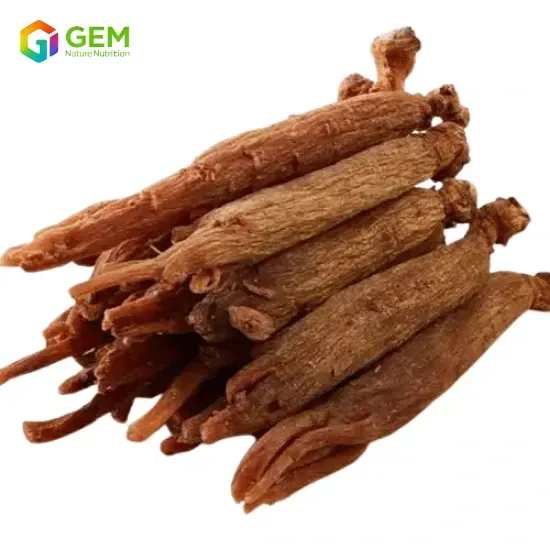
Red Ginseng Extract
Red Ginseng Extract bulk ingredient for B2B formulation sourcing. Request a specification sheet, batch COA, and documentation from GEM.
| 规格名称 | 规格值 |
|---|---|
| Active Ingredients | Ginsengosides (Rg1、Re、Rf、Rc、Rd、Rb1、Rb2) |
| Plant Sourced | Panax ginseng root |
| Forms | Powder; Soft extract |
| Shelf Life | 24 months |
| Availability | Regular storage |
Red Ginseng Extract
Red Ginseng Extract is a standardized botanical raw material produced from the steamed root of Panax ginseng C.A.Meyer and concentrated for ginsenosides (1%–50% by HPLC/UV). GEM supplies this premium Red Ginseng Extract as bulk powder to B2B manufacturers, private-label brands, and nutraceutical formulators worldwide.
Below is a quick-reference summary of the core specifications, sourcing, and documentation that buyers evaluate before placing an order.
Quick View — Product Details
Specification: 1%–50% ginsenosides by HPLC/UV.
Plant Used: Panax ginseng C.A.Meyer.
Active Ingredients: Ginsenosides.
Mesh: 80 mesh.
Certificate: ISO22000; ISO9001; HACCP; Kosher; Halal.
Annual Production Capacity: More than 100 tons.
Solvents: Water; Water and ethanol.
Features: Non-GMO; ETO free; Non-Radiation; USP & EP Standard; Allergen (soy, gluten) free; water-soluble Red Ginseng Extract is also available.
Application: Pharmaceutical and medicine; Dietary supplement; Basic nutritional ingredients; Food and beverages; Food additives and Cosmetics; Feed and pet industry, etc.
Packing: 25 kg/drum, 2 layers PE bags inside.
Last updated: June 21, 2026
What Is Red Ginseng Extract?
Red Ginseng Extract begins with a simple but defining fact: red ginseng is not a distinct botanical species. It is the same plant as ordinary ginseng — Panax ginseng — that has been transformed through a traditional preservation and enhancement process. The "red" in the name refers to the color the root takes on after it is steamed and dried, not to a different genus or growing region.
In practical terms, the extract maker takes the prepared red ginseng root and subjects it to aqueous or hydro-alcoholic extraction, concentration, refining, and drying to yield a fine, standardized powder. The result is an ingredient that carries the concentrated ginsenoside profile associated with steamed Panax ginseng, delivered in a form that is straightforward for manufacturers to blend into capsules, tablets, powders, and functional beverages. This heritage process has been practiced for centuries across Korea and China, and it remains the defining step that separates red ginseng from every other ginseng material on the market.
Major Difference Between Red Ginseng and (White) Normal Ginseng
Many buyers ask how red ginseng differs from the more common "white" ginseng found on the market. The two share the same botanical origin, but the processing path and the resulting material are notably different. The comparison below summarizes the key distinctions that influence formulation and purchasing decisions.
| Comparation | White Ginseng | Red Ginseng |
|---|---|---|
| Color | White | Red |
| Major Processing | Dried without steaming | Steamed at high temperatures, then dried |
| Root Age | Younger | Much older |
| Ginsenoside Assay | Contains standard, unaltered ginsenosides. | Rich in heat-activated, rare ginsenosides. |
| Price(same spec) | Lower | Higher |
White ginseng is produced by simply drying the fresh root without the steaming step, which preserves the root's pale color and its original, unaltered ginsenoside pattern. Red ginseng, by contrast, is made from older roots that are steamed at high temperature before drying. That heat exposure is what generates the characteristic rare ginsenosides and the warming traditional profile that many formulators seek. Because the red process is more labor-intensive and uses older, longer-cultivated roots, the price for the same ginsenoside specification is typically higher.
Source & Botany
Panax ginseng is native to the cool, shaded forested regions of the Korean peninsula, northeastern China, and the Russian Far East. The plant is cultivated rather than wild-harvested for commercial supply, and the roots are generally grown for several years — typically four to six years — before they reach the maturity required for premium red ginseng production. Older roots are preferred for the red process because they carry a denser constituent profile and withstand the steaming step without losing structural integrity. The crop favors well-drained, shaded, humus-rich soils and a temperate climate, which is why its cultivation is concentrated in a relatively narrow geographic band.
It is useful to distinguish true Panax ginseng from related botanicals that are sometimes confused with it. American ginseng (Panax quinquefolius) is a separate species with its own traditional profile. Siberian "ginseng" (Eleutherococcus senticosus) is not a true Panax at all, despite the common name. GEM's Red Ginseng Extract is sourced specifically from Panax ginseng C.A.Meyer root, the species behind the classic steamed red material. For buyers exploring the broader ginseng category, our standard Ginseng Extract page covers the white and unsteamed forms of the same species.
Specification
The specification block below captures the core product parameters that quality, regulatory, and procurement teams review. These values are drawn directly from GEM's product documentation and are maintained for consistency across production batches.
| Specification | Value |
|---|---|
| Active Ingredients | Ginsenosides (Rg1, Re, Rf, Rc, Rd, Rb1, Rb2) |
| Plant Sourced | Panax ginseng root |
| Forms | Powder; Soft extract |
| Shelf Life | 24 months |
| Availability | Regular storage |
The headline assay is the ginsenoside content, standardized from 1% to 50% by HPLC/UV depending on the grade selected. Ginsenosides are the principal triterpene saponins of Panax ginseng, and the listed markers — Rg1, Re, Rf, Rc, Rd, Rb1, and Rb2 — represent the major ginsenoside fractions that analytical laboratories typically quantify. The powder is milled to an 80 mesh grade for consistent blending and dissolution behavior in finished formulations, and it is supplied in both standard powder and soft-extract forms to match different manufacturing needs.
Other Spec for Your More Application
Beyond the standardized ginsenoside powders, GEM offers a range of related red ginseng materials to support different product formats and budget tiers:
- Red ginseng ratio extract 4:1; 10:1; 20:1, etc. — concentration ratios for flexible formulation.
- Red ginseng root raw powder pure — unextracted, full-spectrum root powder.
- Red ginseng root cut / slice / whole — bulk botanical pieces for tea and decoction use.
- Red ginseng root tea bag — convenient single-serve cut material for infusion products.
These additional forms let manufacturers match the ingredient to the final product — from a high-potency standardized capsule to a traditional loose-leaf wellness tea. The ratio extracts in particular give product developers a cost-efficient way to add red ginseng character to blends without committing to a high-percentage standardized grade.
Application Fields
Red Ginseng Extract is a versatile bulk ingredient with broad application across multiple industries. The table below maps the documented application fields to typical product types, expanding on the standard application list maintained in GEM's product records.
The same source record summarizes the application scope as: Pharmaceutical and medicine; Dietary supplement; Basic nutritional ingredients; Food and beverages; Food additives and Cosmetics; Feed and pet industry, etc. Because the powder is available in both standard and water-soluble grades, it can be formulated into clear beverages and stick packs as well as into dry tablet and capsule systems. The 80-mesh particle size further supports even dispersion in powders and smooth integration into compressed tablet matrices.
Production & Quality
GEM's Red Ginseng Extract is manufactured through a controlled, multi-stage process that begins with carefully selected white ginseng root and ends with a tested, packed finished product. The production flow is consistent from batch to batch:
White ginseng selected → Steamed → Dried → Extraction → Concentration → Refining → Drying → Sieving & Mixing → Testing → Packing → Finished products.
Each stage is documented and the finished powder is tested before release. The standard mesh is 80, and packing is standardized at 25 kg per drum with two layers of PE bags inside to protect the material during transit and storage. In-process controls cover extraction solvent ratios, concentration endpoints, and final moisture, while finished-product testing confirms ginsenoside assay, microbial limits, heavy metals, and residual solvents against the relevant standards.
Why Choose GEM's Red Ginseng Extract?
Several factors make GEM a practical supply partner for red ginseng raw material:
With an annual production capacity of more than 100 tons, GEM can support both pilot-scale development and high-volume commercial supply under a single quality system. This scale, combined with the documented production flow and certificate portfolio, gives formulators a stable, traceable source of red ginseng material as their volumes grow.
Frequently Asked Questions
What is the difference between red ginseng and white ginseng?
Both come from the same plant, Panax ginseng. White ginseng is dried without steaming, while red ginseng is steamed at high temperature and then dried. The steaming step gives red ginseng its color, its rare ginsenoside profile, and its traditional "warming" character, and it is typically made from older roots at a higher price.
What does the 1%–50% ginsenoside specification mean?
It refers to the standardized content of ginsenosides in the extract, measured by HPLC or UV. GEM offers grades from a low 1% up to a concentrated 50%, so formulators can choose the potency that matches their target dose and cost structure.
What solvents are used in the extraction?
GEM uses water, or a combination of water and ethanol, as the extraction solvent system. This keeps the process aligned with common food and supplement regulatory expectations while effectively recovering the ginsenoside fraction.
Is the extract Non-GMO and allergen free?
Yes. The product is Non-GMO and free from soy and gluten allergens. It is also Non-Radiation and ETO free, supporting clean-label formulation goals.
What certificates does GEM hold for this product?
The Red Ginseng Extract is covered by ISO22000, ISO9001, HACCP, Kosher, and Halal certifications, and is produced to USP and EP standards.
What is the packing and minimum commercial format?
The standard packing is 25 kg per drum with two layers of PE bags inside. Buyers should contact GEM for MOQ and drum customization options based on their volume.
What is the shelf life and storage condition?
The product carries a shelf life of 24 months under regular storage conditions. Keep the drum sealed and stored in a cool, dry place away from direct sunlight to maintain quality.
Can I get a water-soluble red ginseng extract?
Yes. In addition to the standard powder, GEM offers a water-soluble Red Ginseng Extract grade suitable for beverages and stick-pack applications where rapid dispersion is required.
What ratio extracts and root formats are available?
GEM supplies red ginseng ratio extracts at 4:1, 10:1, 20:1, and other ratios, as well as pure red ginseng root raw powder, cut/slice/whole root, and red ginseng root tea bag material.
Is red ginseng the same plant as Panax ginseng?
Yes. Red ginseng is Panax ginseng C.A.Meyer that has been steamed and dried. It is not a separate species, and it should not be confused with American ginseng or Siberian "ginseng," which are different plants.
Which pesticide and heavy metal standards can be met?
Residual pesticides and heavy metals can be controlled to meet USP561, EC396(2005), or pesticide-free requirements, depending on the buyer's target market and compliance needs.
How does steaming change the ginsenosides?
The high-temperature steaming used in red ginseng production converts some standard ginsenosides into less polar, rare ginsenoside forms. This is why red ginseng is described as rich in heat-activated rare ginsenosides compared with the unsteamed white form.
Further Reading
Explore related GEM ingredients and resources to support your formulation and sourcing decisions:
- Ginseng Extract — the white and unsteamed forms of Panax ginseng.
- Reishi Mushroom Extract — a complementary traditional wellness botanical.
- Lion's Mane Mushroom Extract — a popular adaptogen-blend ingredient.
- Milk Thistle Extract — another standardized plant extract for wellness formulations.
- Chinese Magic Herb: Ginseng — background on the ginseng category and its heritage.