
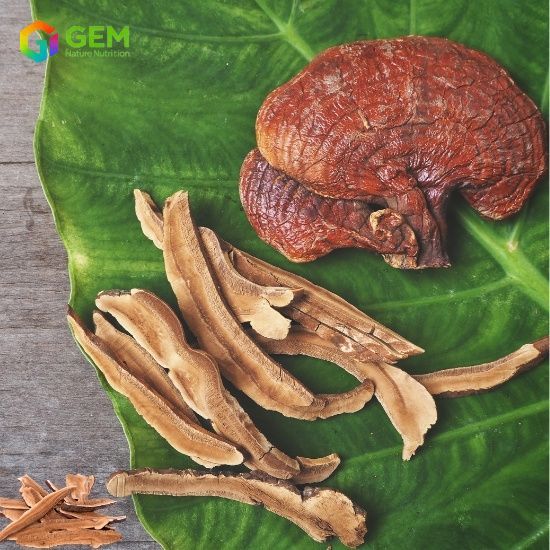
Reishi Mushroom Extract
Reishi Mushroom Extract bulk ingredient for B2B formulation sourcing. Request a specification sheet, batch COA, and documentation from GEM.
| 规格名称 | 规格值 |
|---|---|
| Active Ingredients | Polysaccharides;Triterpenes. |
| Latin Name | Ganoderma lucidum (Curtis) P. Karst. |
| Assay | 10-50% by UV |
| Shelf Life | 24 months |
| Solvents | Water |
Reishi Mushroom Extract
Last updated: June 21, 2026
Reishi Mushroom Extract Details
The quick-view block below summarizes the commercial and quality specifications GEM offers for bulk Reishi Mushroom Extract. All values are stated verbatim from our standard product documentation and can be tailored on request.
Specification: 10-50% by UV
Mesh: 80mesh
Certificate: ISO22000; ISO9001; HACCP; Kosher; Halal
Annual Production Capacity: More than 100 tons
Features: Non-GMO; ETO free; Non-Radiation; USP&EP Standard; Allergen (soy, gluten) free; Fruiting body reishi mushroom extract.
Application: Pharmaceutical and medicine; Dietary supplement; Basic nutritional ingredients; Food and beverages; Food additives and Cosmetics; Feed and pet industry. etc.
Formulation context: Traditional mushroom ingredient for food and supplement formulations; no disease-prevention or treatment outcome is implied.
GEM's reishi extract is derived from the fruiting body of Ganoderma lucidum. Buyers should confirm the declared source material, triterpene and polysaccharide specification, current certificates, and available capacity through the applicable COA and quotation.
What Is Reishi Mushroom Extract?
Reishi Mushroom Extract (Ganoderma lucidum) — known as Lingzhi in Chinese — is one of the most revered tonifying botanicals in East Asian wellness traditions, with a recorded history of use stretching back more than two thousand years. As health awareness continues to grow in modern society, this precious medicinal fungus has gradually become widely recognized well beyond Asia, appearing in capsules, powders, functional beverages, and cosmetic bases. Endowed with a long cultural heritage and profound historical legacy, reishi carries exceptional nutritional and health-preserving value, making it a treasured choice for daily wellness.
Maximum Utilization: Spores, Oil, and Extract
To offer the most comprehensive Reishi solutions, GEM utilizes every stage of the mushroom's life cycle. Reishi Mushroom Extract is a concentrated water/ethanol extract from the fruiting body, ideal for capsules, tablets, and powdered blends. Reishi Spore Powder is the "essence" of the mushroom; we supply cell-wall-broken reishi spore powder for maximum absorption, a premium ingredient for high-end formulations. Reishi Spore Oil is a premium, lipid-soluble fraction rich in triterpenoids, ideal for high-end softgels and cosmeceutical applications.
Source & Botany (Ganoderma lucidum)
Understanding the botany of Ganoderma lucidum helps formulators appreciate why sourcing and part-used decisions drive both quality and price. Reishi is a polypore bracket fungus in the family Ganodermataceae that releases spores through a fine layer of pores on the underside of a woody, kidney-shaped or fan-shaped cap. In nature it grows on decaying hardwood logs across China, Japan, Korea, and other parts of East Asia, and is also found in suitable tropical and subtropical regions. The mature cap displays the characteristic lacquered, varnished sheen — deep reddish-brown to dark brown — that gives the species its Latin name lucidum, meaning "shiny." Because wild reishi is scarce and inconsistent, the commercial supply is almost entirely cultivated on logs or sterilized sawdust substrates.
Cultivation matters for chemistry. A fruiting body grown slowly on wood develops the dense, bitter triterpene and beta-glucan matrix that defines premium reishi, while mycelium grown rapidly on grain produces a very different profile. GEM sources only fruiting-body material, which is why our specification emphasizes both polysaccharides and a confirmed triterpene-positive result. For adaptogen stacks, reishi pairs naturally with Lion's Mane Mushroom Extract or with Red Ginseng Extract and Ginseng Extract in traditional vitality blends.
Reishi Mushroom Extract Specification
The table below is our standard certificate-of-analysis framework for bulk Reishi Mushroom Extract. It is preserved exactly as documented and reflects routine in-house and third-party testing. Every lot ships with a corresponding COA.
| Test Item | Specification | Testing Method |
|---|---|---|
| Assay(Polysaccharides) | ≥ 10% | UV |
| Triterpene | Positive | UV |
| Appearance | Brown Powder | Visual |
| Odor | Characteristic | Organoleptic |
| Taste | Characteristic | Organoleptic |
| Mesh Size | 100% pass 80 mesh | 80mesh screen |
| Loss on Drying | ≤ 7% | 5g/100°C/2.5hrs |
| Ash | ≤ 9% | 2g/525°C/3hrs |
| As | ≤ 1% | ICP-MS |
| Pb | ≤ 2% | ICP-MS |
| Hg | ≤ 0.2% | ICP-MS |
| Cd | ≤ 1% | ICP-MS |
| Pesticide Residue | Meet USP 561 | GC-HPLC |
| Total Plate Count | ≤ 10000cfu/g | GB 4789.2 |
| Yeast & Mould | ≤ 100cfu/g | GB 4789.15 |
| Coliforms | Negative | GB 4789.3 |
| Pathogens | Negative | GB 29921 |
Remark: If you have special quality request, please check with us.
The polysaccharide assay is measured by UV spectroscopy, and we offer standardized grades from 10% up to 50% polysaccharides to match different formulation cost targets and label claims. The "Triterpene: Positive" line confirms the presence of the bitter ganoderic-acid fraction that distinguishes genuine fruiting-body extract from mycelium-based alternatives. Heavy-metal limits are verified by ICP-MS, microbial loads by standard plate methods, and pesticide residues against the USP 561 compositional guideline.
Application Fields
Bulk Reishi Mushroom Extract is a versatile raw material across multiple finished-product categories. The table below maps our standard application fields to typical use cases, drawn directly from the product's documented application scope.
Production & Quality
Production Flow
GEM's manufacturing chain for Reishi Mushroom Extract follows a controlled, fully documented process from raw material to finished goods: Selected Reishi Mushroom — Extraction — Concentration — Refining — Drying — Sieving & Mixing — Testing — Packing — Finished Products. Each stage is monitored to protect the integrity of heat-sensitive polysaccharides and the bitter triterpene fraction. Refining removes insoluble fiber and residual substrate, drying locks in a free-flowing brown powder, and final sieving through an 80-mesh screen support uniform particle size for consistent blending.
Why Is Reishi Mushroom Price So Different in the Current Market?
If you are comparing Reishi (Ganoderma lucidum) quotes, you will notice a significant price gap between suppliers. When selecting a Ganoderma lucidum supplement, the most critical factor is the part of the fungus used. Understanding this distinction protects your brand from costly quality surprises.
2. The Low-Cost Alternative: Reishi Mycelium (on Grain)
Many low-cost extracts are produced using mycelium — the root-like structure of the fungus — grown on sterilized grains (rice, oats, or sorghum) in a laboratory. This process is industrial and fast (weeks instead of months), which drastically lowers production cost. However, mycelium-on-grain products are typically very low in triterpenoids and high in alpha-glucans (sugars/starch), inflating a naive polysaccharide reading without delivering expected reishi activity.
How to Identify Quality Reishi Extract?
When sourcing for your brand, don't just look at the "Polysaccharide" percentage, as maltodextrin also contains polysaccharides and can be used to inflate numbers. Always ask your supplier: Is this extract 100% from the fruiting body or from mycelium? What is the triterpenoid percentage (triterpenes are only found in significant levels in the fruiting body)? A genuine fruiting-body reishi extract will show a confirmed triterpene-positive result on the COA and will not rely on starch fillers to hit its polysaccharide claim. GEM welcomes third-party verification of any lot.
Frequently Asked Questions
What is the difference between Reishi fruiting body and mycelium extract?
Fruiting-body extract comes from the mature mushroom cap and contains high levels of both beta-glucans and triterpenes. Mycelium-on-grain extract is produced from the root-like network grown on starch substrates; it is faster and cheaper but typically low in triterpenes and high in alpha-glucans. GEM supplies only fruiting-body material.
What active compounds are standardized in your Reishi Mushroom Extract?
Our extract is standardized for polysaccharides (measured by UV) and confirmed triterpene-positive. These two fractions — water-soluble polysaccharides and lipid-soluble triterpenoids — represent the primary bioactive classes associated with reishi's traditional wellness uses.
What polysaccharide assay levels do you offer?
The standard specification covers 10% to 50% polysaccharides by UV, allowing brands to select a grade that matches their label claim and cost target. Custom assays outside this range can be discussed with our technical team.
Is your Reishi extract suitable for vegan and allergen-free formulations?
Yes. The product is derived from the fruiting body of Ganoderma lucidum and is free from soy and gluten allergens. It is also Non-GMO, ETO free, and Non-Radiation, supporting clean-label and vegan product positioning.
What certifications does GEM hold for this product?
The product is covered by ISO22000, ISO9001, HACCP, Kosher, and Halal certifications, and production follows USP and EP standards. Documentation is available on request for each shipment.
How should Reishi Mushroom Extract be stored?
Store in a cool, dry place away from direct light and moisture, in the original sealed container, to preserve the polysaccharide and triterpene profile. Properly stored material maintains quality through its stated shelf life; specific shelf-life data is provided on the COA.
What does "triterpene positive" mean on the spec sheet?
"Triterpene: Positive" confirms the presence of the bitter ganoderic-acid fraction by UV testing. Because triterpenes are found almost exclusively in the fruiting body, a positive result distinguishes genuine reishi from mycelium-based or adulterated material.
What is the annual supply capacity?
GEM's annual production capacity for this ingredient is more than 100 tons, enabling stable supply for both growing brands and established manufacturers with recurring volume requirements.
Further Reading
Explore related ingredients and resources from GEM to support your formulation and sourcing decisions: