
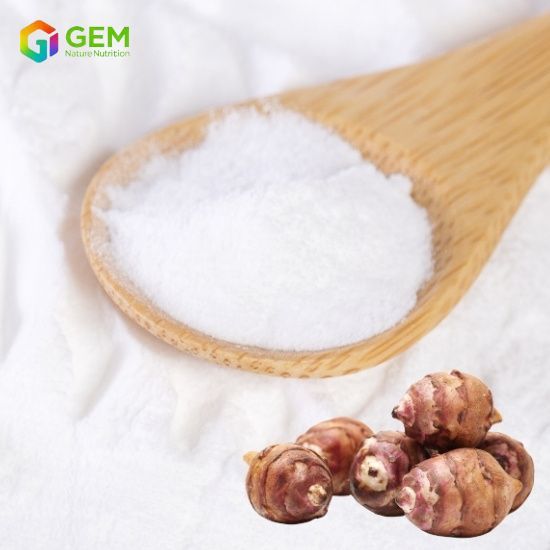
Inulin
Inulin bulk ingredient for B2B formulation sourcing. Request a specification sheet, batch COA, and documentation from GEM.
| 规格名称 | 规格值 |
|---|---|
| Appearance | White fine powder |
| Assay | 90%; 95%HPLC |
| Plant Used | Jerusalem artichoke; Chicory |
| Packing | 25kg/bag |
| Stock | Regular storage |
Inulin
Inulin is a natural fructan polysaccharide and prebiotic dietary fiber sourced from chicory root and Jerusalem artichoke. GEM supplies high-purity Inulin at 90% and 95% HPLC assay grades, serving global B2B customers across the dietary supplement, functional food, and fructooligosaccharide (FOS) production industries with consistent, food-grade quality.
Last updated: June 21, 2026
Inulin Quick View
Specification: Inulin 90% and 95%
Plant Source: Jerusalem artichoke; Chicory
Certificate: ISO22000; ISO9001; FSSC22000; GMP; Kosher&Halal
Annual Production Capacity: More than 500 tons
Features: Light sweet taste; Water-soluble; Allergen (soy, gluten) free; Pesticides free; Low fat; Low calories; Long-life stability.
Application: Dietary supplement; Basic nutritional ingredients; Food and beverages; Food additives and Cosmetics, etc.
What Is Inulin?
Inulin is a natural polysaccharide found in many plants. As a type of fructan, it serves as a natural, water-soluble dietary fiber. Chicory and Jerusalem artichoke are the two primary raw materials for commercial production, and GEM offers inulin powder sourced from both chicory and Jerusalem artichoke to meet different customer positioning needs.
Structurally, inulin belongs to the fructan family: it is a mixture of linear beta(2→1) linked fructose chains, typically terminated by a single glucose unit. The length of each chain — its degree of polymerization — varies from a few to several dozen fructose units depending on the plant source and extraction method. This structure is precisely what makes inulin behave as a prebiotic fiber: human and animal digestive enzymes cannot cleave these bonds in the upper gastrointestinal tract.
Inulin powder has an extremely low caloric value and travels directly to the colon. There, it is selectively utilized by beneficial gut bacteria, such as Bifidobacterium. Because it resists digestion upstream, it contributes negligible metabolizable energy while delivering bulk and functional benefits downstream.
It is a perfect functional food ingredient used to develop low-fat, high-fiber products without compromising on taste or texture. As a premium prebiotic dietary fiber, it serves as a high-quality raw material for the production of fructooligosaccharides (FOS) and high-fructose syrup. Whether used as a natural fat replacer or a nutritional fortificant, Inulin helps manufacturers meet the growing demand for healthy, plant-based food solutions. For brands building complementary fiber systems, our Xylo-oligosaccharide offers another well-established prebiotic option worth evaluating alongside inulin.
Source & Botany
Inulin is a reserve carbohydrate stored in the underground organs of a wide range of plants. Botanically, it accumulates in the roots, rhizomes, or tubers of species across the Asteraceae (daisy) family and beyond, and it is estimated to occur naturally in tens of thousands of plant species worldwide — including agave, garlic, onion, wheat, banana, and asparagus.
The two commercial sources GEM works with are:
- Chicory (Cichorium intybus L.) — a perennial Asteraceae plant whose taproot is the world's dominant commercial source of inulin. Chicory is cultivated across Europe and China, and its root is valued for a clean flavor profile and reliable inulin accumulation.
- Jerusalem artichoke (Helianthus tuberosus L.) — a perennial sunflower relative native to North America, propagated from tubers. It is the other principal industrial source and commands the largest share of the global inulin market.
Both plants store inulin as their principal reserve carbohydrate in underground storage organs, which is why they are preferred for commercial extraction over leafy or fruit sources. In chicory root and Jerusalem artichoke tubers, inulin typically accounts for a substantial proportion of the fresh weight, with the exact concentration influenced by cultivar, growing region, harvest timing, and storage conditions.
While agave is another well-known inulin- and fructan-bearing crop traditionally used in Mexico, GEM's inulin offering is sourced specifically from chicory and Jerusalem artichoke, giving customers a clear, traceable botanical origin for labeling and regulatory purposes.
Chicory Inulin vs. Jerusalem Artichoke Inulin
Although both sources yield the same core molecule, the two commercial grades differ in market positioning, available assay, and shelf life. The table below summarizes the key distinctions GEM's customers should consider when selecting a source.
| Source | Plant Used | Spec | Market Share | Shelf Life |
|---|---|---|---|---|
| Chicory Inulin | Chicory | 90% | 10%-20% | 48months |
| Jerusalem artichoke Inulin | Jerusalem artichoke | 90%&95% | 80%-90% | 60months |
Jerusalem artichoke inulin is the volume leader, offering both 90% and 95% assay options and the longest shelf life. Chicory inulin, by contrast, is the botanical referenced in the EU bowel-function health claim and is frequently chosen by brands targeting that specific regulatory positioning. Both are available from GEM under the same quality system.
Inulin 90% Specification
The specification below applies to GEM's 90% inulin grade. All values are verified by the listed test methods.
| Testing Item | Specification | Test Method |
|---|---|---|
| Appearance | White or off white powder | Visual |
| Taste and Smell | Light sweet and odourless | GB/T41377-2022 |
| Impurity | No visible impurities | GB/T41377-2022 |
| Inulin Content% | ≧ 90% | HPLC |
| Other Saccharides (fructose+sucros++gl ucose)/% | ≤10% | HPLC |
| Ash; g/100g | ≤ 0.2 % | GB5009.4-2016 |
| Water; g/100g | ≤ 4.5 % | GB5009.3-2016 |
| PH | 5.0-7.0 | GB/T41377-2022 |
| Total Plate Count | ≤ 1000 cfu/g | GB4789.2-2016 |
| Molds and Yeasts | ≤ 100 cfu/g | GB4789.15-2016 |
| E. Coli | ≤ 10 cfu/g | GB4789.38-2012 |
Remark: 90% inulin, the specification is the same whether it's sourced from Chicory or Jerusalem artichoke.
For brands requiring a higher assay, GEM additionally supplies a 95% inulin grade (Jerusalem artichoke sourced), suitable for applications where maximum inulin content per gram is preferred.
Application Fields
Inulin's functional flexibility spans multiple product categories. The table below maps common application fields to representative use cases.
| Application Field | Details |
|---|---|
| Functional Foods & Beverages | Fiber-fortified drinks, bars, baked goods, and dairy alternatives |
| Infant & Adult Nutrition | Fat replacer and fiber fortificant (not for infant formula in China) |
| FOS Production | Raw material for fructooligosaccharide and oligofructose manufacturing |
| Private Label & Contract Manufacturing | Chicory and Jerusalem artichoke sources at 90% and 95% assay |
Production & Quality
Production Flow Process
GEM's inulin is produced through a controlled, multi-stage process designed to preserve the native fructan structure while meeting food-grade microbiological limits:
Raw material (Chicory or Jerusalem artichoke) → Cleaning → Cutting → Extraction → Purification → Concentration → Spray Drying → Inspection → Packing → Finished Products.
Each batch passes through inspection against the specification before packing. With an annual production capacity of more than 500 tons, GEM supports both spot orders and long-term supply agreements for private label and contract manufacturing customers.
Quality System & Certificates
Inulin is produced and managed under a comprehensive quality framework. GEM holds ISO22000, ISO9001, FSSC22000, and GMP certifications, and the product is available with Kosher and Halal certification to meet diverse market and religious requirements. Routine testing covers identity, assay (HPLC), microbiology, heavy-metal and physicochemical indicators, and sensory attributes according to the methods listed in the specification table.
Safety and Regulations
China
- Approval: In 2009, the Ministry of Health of the People's Republic of China issued Announcement No. 5, officially approving inulin as a New Resource Food. It is permitted for use in all food categories except for infant formula.
- National Standards: The quality of inulin is strictly regulated under the National Standard GB/T 41377-2022: Quality Requirements for Inulin.
- Specifications: This standard defines sensory indicators (appearance, odor, and taste) and establishes core physicochemical requirements. For instance, inulin content (on a dry basis) must be at least 86.0%, while the total content of free sugars (glucose, fructose, and sucrose) must not exceed 14.0%.
- Testing Methods: The standard primarily utilizes High-Performance Liquid Chromatography (HPLC).
European Union
In 2015, the EU approved a health claim stating that "chicory inulin contributes to normal bowel function." To qualify for this claim, the product must ensure a daily consumer intake of 12 grams.
Frequently Asked Questions
1. Chicory inulin vs. Jerusalem artichoke inulin — which should I choose?
Jerusalem artichoke inulin (90% & 95%) dominates the market (~80–90% share) with up to 60 months shelf life. Chicory inulin (90%) suits EU bowel-function claim positioning with 48 months shelf life. Choose Jerusalem artichoke for maximum shelf life and assay flexibility; choose chicory when your label references the EU chicory inulin bowel-function claim.
2. What is a typical daily prebiotic dose?
FDA GRAS suggests 5 g/day effective intake. EU bowel-function claim requires 12 g/day of chicory inulin. Confirm labeling with your regulatory team, as requirements differ by market and by the specific health claim you intend to make.
4. Is inulin heat-stable for baking?
Inulin tolerates moderate processing temperatures. Confirm stability parameters for your specific baking or extrusion process during formulation trials, as final texture and solubility depend on the matrix, moisture, and thermal profile of your product.
5. What quality documents do you provide?
We provide Specification Sheet, COA, and MSDS upon request. ISO, FSSC22000, Kosher, and Halal certificates are available for qualified orders.
6. What does "HPLC" assay mean for inulin?
HPLC (High-Performance Liquid Chromatography) is the analytical method used to quantify inulin content, referenced both in GEM's specification and in China's national standard GB/T 41377-2022. A "90% HPLC" grade means the inulin content is verified at ≥ 90% by this method, giving buyers a precise, lab-backed measure of purity rather than an estimate.
7. Is inulin soluble, and how does it behave in formulations?
Inulin is water-soluble and has a light, sweet taste with low caloric value. In solution it contributes body and a mild mouthfeel, and in dry systems it can improve texture and act as a partial fat replacer. Its solubility and clean flavor make it suitable across beverages, baked goods, and powder blends.
8. What is the shelf life and how should it be stored?
Shelf life is 48 months for chicory inulin and 60 months for Jerusalem artichoke inulin when stored under recommended dry conditions. Keep the material in a cool, dry place, sealed away from moisture and strong odors to preserve the low water content and long-life stability noted in the specification.
9. Is inulin suitable for allergen-free and clean-label products?
Yes. GEM's inulin is free from soy and gluten allergens and is produced pesticide-free, supporting clean-label and allergen-sensitive formulations. It is also vegan and plant-derived, which aligns with plant-based product positioning.
10. Can inulin replace sugar or fat in recipes?
Inulin's light sweetness and fat-like texture allow it to partially replace sugar and fat while adding dietary fiber and lowering caloric density. It works as a natural fat replacer and nutritional fortificant, helping manufacturers develop reduced-fat, high-fiber products without compromising taste or texture.
11. Do you supply both 90% and 95% grades?
Yes. GEM supplies 90% inulin from both chicory and Jerusalem artichoke, and a higher 95% inulin grade from Jerusalem artichoke. The 90% specification is identical regardless of botanical source; the 95% grade is selected where maximum inulin content per serving is desired.
12. What packaging and order quantities are available?
Packaging is arranged to protect the free-flowing powder and support both trial and bulk volumes, backed by GEM's more than 500 tons annual capacity. Specific pack sizes and private-label options are confirmed with the sales team based on your order and destination requirements.
Further Reading
Explore related GEM ingredients and resources:
- Inulin product page — specifications, grades, and sourcing
- Xylo-oligosaccharide — another prebiotic fiber for synbiotic systems
- Pea Protein Powder — plant protein for fiber-fortified nutrition
- Myo-Inositol — inositol-family ingredient for wellness blends
- Soy Isoflavones — women's nutrition combinations