
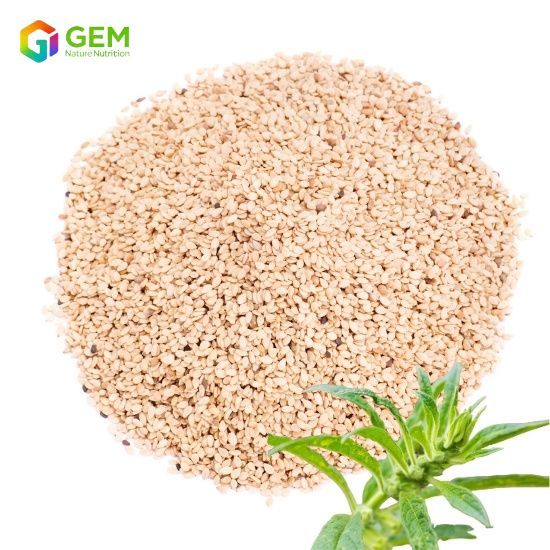
Sesame Seed Extract
Sesame Seed Extract bulk ingredient for B2B formulation sourcing. Request a specification sheet, batch COA, and documentation from GEM.
| 规格名称 | 规格值 |
|---|---|
| Active Ingredients | Sesamin; Sesamolin |
| Sesamin CAS NO. | 607-80-7 |
| Sesamolin CAS NO. | 526-07-8 |
| Shelf Life | 24 months |
| Solvents | Water and ethanol |
Sesame Seed Extract
Sesame seed extract is a concentrated botanical ingredient derived from the seeds of Sesamum indicum L., standardized for its naturally occurring lignans — most notably sesamin, sesamolin, and sesamol. GEM supplies bulk sesame seed extract powder at 5%–99% assay (HPLC) for B2B manufacturers of dietary supplements, functional foods, and personal care products. Unlike crude sesame oil or whole-seed powder, a standardized sesame extract delivers a consistent, measurable load of bioactive lignans, which makes it far easier to formulate repeatable products at scale.
Sesame Seed Extract Quick View
Specification: 5%-99% by HPLC
Mesh: 40mesh
Certificate: ISO22000; ISO14001; ISO9001; GMP; Kosher; Halal
Annual Production Capacity: More than 20 tons
Application: Pharmaceutical and medicine; Dietary supplement; Basic nutritional ingredients; Food and beverages; Food additives and Cosmetics; Feed and pet industry. etc.
Last updated: June 21, 2026
What Is Sesame Seed Extract?
Sesame seed extract is a concentrated form of the bioactive compounds found in Sesamum indicum — the sesame plant, known as "Zhi Ma" in Chinese and cultivated across Asia, Africa, and the Middle East for more than 5,000 years. While sesame seeds are a familiar culinary staple, the functional value of the seed sits in a specific family of polyphenolic compounds called lignans. GEM's extract is standardized to deliver high concentrations of sesamin and sesamolin, the two most studied lignans for metabolic and oxidative-stress support.
Whole sesame seeds naturally contain 0.5%–1.5% lignans by weight, with sesamin and sesamolin making up the bulk. By isolating and concentrating these molecules, a standardized sesame seed extract turns a low-dose food component into a precise, label-friendly ingredient that formulators can dose with confidence. That is the core reason the extract — rather than cold-pressed oil or milled seed — has become the preferred raw material for supplement and cosmeceutical brands.
The sesame plant itself is an annual flowering herb in the Pedaliaceae family. It thrives in warm, well-drained conditions and is unusually resilient: traditional cultivars were prized for tolerating drought and for their non-GMO, allergen-friendly profile. Modern commercial supply is dominated by producers in India, China, Myanmar, and Sudan, with processing and standardization increasingly handled by integrated ingredient manufacturers such as GEM that control extraction from seed to finished powder.
The Active Compounds in Sesame Seed Extract
A standardized sesame seed extract is defined less by a single molecule than by a small cluster of related lignans. Understanding each one helps formulators choose the right assay grade and communicate benefits accurately.
3. Sesamol
Sesamol is a phenolic derivative formed from sesamolin, notable for its strong free-radical-scavenging activity. It is lipophilic, which means it integrates well into oil-based and emulsion systems — a useful property for cosmetic and food applications. Because sesamol is generated during refining and storage, the stability of the finished powder depends heavily on controlled processing and low-temperature handling, both of which GEM manages within its production workflow.
Sesame Seed Extract Quality Specification
| Test Item | Specification | Method |
|---|---|---|
| Sesamin assay | ≥ 90.0 | HPLC |
| Identification | Positive | TLC |
| Appearance | Off white powder | Visual |
| Odor | Characteristic | Organoleptic |
| Powder Size | ≥ 95% through 40 mesh | USP #40 Sieve |
| Loss on Drying | ≤ 0.5% | USP-NF<731> |
| Residue on Ignition | ≤ 0.5% | USP-NF<281> |
| Residual Ethanol | ≤ 5,000 μg/g | USP-NF<467> |
| Pesticide Residues | USP<561> | USP-NF<561> |
| Aflatoxin B1 | ≤2 μg/kg | USP-NF<561> |
| Aflatoxins(B1,B2,G1,G2) | ≤4 μg/kg | USP-NF<561> |
| Total Heavy Metals | ≤ 10 μg/g | USP-NF<231> |
| Arsenic (As) | ≤ 1.0 μg/g | ICP-MS |
| Cadmium (Cd) | ≤ 0.5 μg/g | ICP-MS |
| Lead (Pb) | ≤ 1.0 μg/g | ICP-MS |
| Mercury (Hg) | ≤ 0.1 μg/g | ICP-MS |
| Total Plate Count | ≤ 1,000 cfu/g | USP-NF<2021> |
| Molds and Yeasts | ≤ 100 cfu/g | USP-NF<2021> |
| Salmonella | Absence/10g | USP-NF<2022> |
| E. Coli | Absence/10g | USP-NF<2022> |
| Staphylococcus aureus | Absence/10g | USP-NF<2022> |
Remark: Heavy-metal, microbial, aflatoxin, and pesticide limits follow USP/EP-aligned methods suitable for international B2B supply. GEM provides a full Specification Sheet, COA, and MSDS on request for qualified commercial orders.
Production Process
Sesame seeds→Extraction→Concentration→Coarse crystallization→Centrifugation→Dissolve→Decolorization→Crystallization→Centrifugation→Drying→Sieving&Mixing→Metal detection→Packing→Finished products.
GEM's process begins with cleaned, food-grade sesame seeds and uses solvent extraction followed by multi-stage crystallization to isolate the lignan fraction. Decolorization and controlled drying preserve the sesamin-to-sesamolin balance while keeping residual solvent and moisture within the tight limits shown in the specification table. Every batch passes metal detection and is blended to a uniform 40-mesh powder before release, which supports consistent assay and reliable performance on encapsulation and sachet lines.
Application Fields
Sesame seed extract is one of the more versatile plant lignans on the market because it bridges food, supplement, and cosmetic categories without a strong taste or color burden at typical use levels. Its allergen-friendly profile (free from soy and gluten, non-GMO) also fits clean-label positioning that many buyers now require. For companion-animal and livestock formats, it pairs naturally with plant-protein ingredients such as Hemp Protein Powder in complete nutritional premixes.
Sesame Seed Extract in Functional Foods & Beverages
In food systems, sesame extract is valued for what it does not do: it adds lignan functionality without the heavy flavor of whole sesame or the cost of purified isolates. Typical use cases include:
Because the powder is lipophilic-friendly and off-white, it blends cleanly into most matrices. Brands should confirm flavor masking at their target dose and run small-scale stability checks, especially in clear beverages where slight color shift over shelf life is possible.
Sesame Seed Extract in Nutraceuticals & Dietary Supplements
The supplement category is the largest outlet for standardized sesame seed extract. Common finished formats include:
Capsule and tablet manufacturers generally run the 40-mesh powder without special flow aids, though high-speed lines may benefit from a light granulation step. Typical consumer-facing serving sizes in finished products range from a few hundred milligrams to roughly one gram of extract per day, depending on assay — final dosing must comply with regulations in the target market.
Sesame Seed Extract in Cosmetics & Personal Care
Sesamol and sesamin are lipophilic antioxidants that integrate well into oil phases, emulsions, and serums. In cosmeceutical applications the extract is used to:
For cosmetic use, GEM's off-white, low-odor powder is easier to incorporate than crude sesame oil and avoids the comedogenic feel some oils carry. Formulators should evaluate compatibility in the intended pH and preservative system during pilot batches.
Formulation Tips for Manufacturers
2. Solubility and Dispersion
The powder is partially lipophilic and only sparingly water-soluble. In beverages, pre-disperse in a small amount of oil, lecithin, or a gum system, or use a soluble carrier during blending. In tablets and capsules, standard dry granulation is usually sufficient.
3. Stability and Storage
Sesamol content can drift if the powder is exposed to heat, light, or air over long storage. Keep material in sealed, low-moisture containers away from direct light, and use oxygen-reduced or opaque primary packaging for long-shelf-life finished goods. GEM's low residual-ethanol and low-loss-on-drying specs support stable blends.
4. Compatibility and Blending
Sesame seed extract is often compared with other plant antioxidants. The table below helps formulators pick the right active for a given claim and format.
The practical takeaway: sesame extract is the stronger choice when a brand wants a lignan-based, liver-metabolism story with clean-label and cosmetic flexibility. It also combines well with the others in multi-botanical stacks rather than competing against them.
Quality Control, Certifications & Compliance
GEM holds ISO22000, ISO14001, ISO9001, and GMP systems, and supplies Kosher and Halal certificates for qualified commercial orders. Material is produced to USP and EP referenced methods, with every batch released against the full specification table above. Key control points include:
Buyers receive a Specification Sheet, COA, and MSDS on request. GEM recommends reviewing these documents during supplier qualification and keeping them on file for audit readiness.
Market & Regulatory Context
In the United States, sesame seed and its components are traditional foods, and standardized extracts are typically marketed under dietary-supplement frameworks with structure/function claims. In the European Union, novel-food and botanical rules differ by member state, and health claims on botanicals are tightly restricted — brands should avoid authorized-health-claim language and rely on permitted nutritional and function statements. In Asia, sesame has strong traditional-food heritage that supports functional-food positioning.
Labeling should disclose the botanical source (Sesamum indicum), the standardized lignan content, and any allergen statements required locally. Because sesame is a recognized allergen in several markets, even a refined extract should be assessed against local allergen-labeling rules — GEM's soy- and gluten-free production does not remove the need to evaluate sesame allergen labeling where applicable.
B2B Buying Guide — MOQ, Packing & Customization
GEM supports both pilot and full-scale B2B orders of sesame seed extract, with an annual capacity exceeding 20 tons to cover steady contract supply. For buyers planning a new SKU, the typical workflow is:
- Sample and documents: Request a small sample plus Specification Sheet, COA, and MSDS to validate assay and flow in your process.
- Assay selection: Confirm the target sesamin assay (5%–99%) and mesh (standard 40 mesh) for your format.
- Order quantity: Discuss minimum order quantity and lead time with GEM; volume pricing applies at contract scale.
- Packing: Material ships in export-standard fiber drums with double polyethylene liners suitable for international freight; final pack size and drum specification are confirmed at order.
- Certificates: Kosher, Halal, and ISO/GMP certificates are arranged for qualified commercial orders.
For multi-ingredient programs, sourcing sesame alongside complementary botanicals such as Reishi Mushroom Extract and Lion's Mane Mushroom Extract from one qualified manufacturer reduces paperwork, lead time, and quality risk. GEM's private-label and ODM services cover custom blends, granulation for improved flow, and assay tuning matched to your label claim and cost target.
Because sesame extract pricing is driven by assay grade and sesamin purity, higher-assay material commands a premium. Plan formulation cost around the effective lignan dose delivered per finished serving, not just the powder weight. GEM's team can advise on the most cost-effective grade for your claim and format.
Frequently Asked Questions
1. What is sesame seed extract made from?
Sesame seed extract is produced from the seeds of Sesamum indicum (sesame). GEM uses cleaned, food-grade seeds and isolates the lignan fraction — primarily sesamin, sesamolin, and sesamol — through extraction and crystallization. The result is a standardized off-white powder rather than an oil.
2. What is the difference between sesame seed extract, sesame extract, and sesamin?
"Sesame seed extract" and "sesame extract" are commonly used for the same standardized botanical powder. "Sesamin" is the single flagship lignan inside it; high-assay extracts (up to 99% by HPLC) are essentially concentrated sesamin, while lower assays retain more of the natural sesamolin and sesamol balance.
4. Is sesame seed extract water-soluble?
It is only partly lipophilic and sparingly water-soluble. In beverages, pre-disperse it in oil, lecithin, or a gum system, or use a soluble carrier. In capsules and tablets, standard dry granulation is usually sufficient.
5. What certifications does GEM provide?
GEM holds ISO22000, ISO14001, ISO9001, and GMP systems, and supplies Kosher and Halal certificates for qualified commercial orders. A Specification Sheet, COA, and MSDS are available on request.
8. How should the powder be stored?
Store in a sealed, low-moisture container away from direct light and heat. Sesamol content can drift under prolonged heat, light, or air exposure, so oxygen-reduced or opaque primary packaging helps protect long-shelf-life finished goods.
9. What quality controls confirm the material is genuine?
Every batch is released against TLC identity and HPLC sesamin assay (≥ 90.0%), plus tight aflatoxin, pesticide, heavy-metal, and microbial limits. These controls follow USP/EP-referenced methods suitable for international B2B supply.
10. What are typical use levels in finished products?
Use levels vary by assay and format. Food and cosmetic systems often use low-dose powder, while supplement capsules may deliver a few hundred milligrams to about one gram of extract per daily serving. Final dosing must comply with regulations in your target market; GEM provides formulation guidance but not medical advice.
Further Reading
- Reishi Mushroom Extract — liver-support botanical often paired with sesame lignans
- Lion's Mane Mushroom Extract — healthy-aging and cognitive botanical for multi-ingredient blends
- Inulin — prebiotic fiber for functional-food and beverage systems
- Red Clover Extract — GEM's botanical expertise profile on isoflavone ingredients