
Red Clover Extract: Isoflavone Profile and B2B Formulation Guide
Red clover extract, derived from the flowering tops of Trifolium pratense L., is a botanical ingredient used in women’s-wellness supplement concepts. This guide examines the plant, its isoflavone markers, quality verification, and formulation context. It does not establish that the ingredient balances hormones, relieves menopause symptoms, or treats any condition.
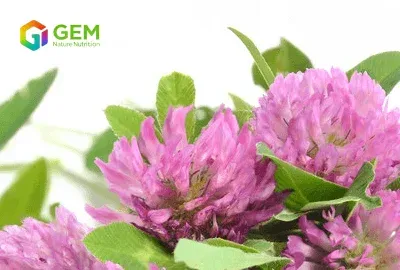
What Is Red Clover?
Red clover (Trifolium pratense L.) is a short-lived perennial herb belonging to the Fabaceae (legume) family. It originates from Europe and West Asia and is now widely distributed across temperate regions around the world. The plant has been cultivated for centuries, both as a high-protein forage and cover crop and as a medicinal herb.
Botanically, red clover is easy to recognize:
- Growth habit: An upright or semi-prostrate perennial that typically reaches 20–80 cm in height.
- Leaves: Trifoliate (three leaflets) with the characteristic pale V-shaped marking common to clovers.
- Flowers: Dense globular to ovoid flower heads in shades of pink to reddish-purple, which are the primary botanical part harvested for extract production.
- Roots: A deep taproot system that supports nitrogen fixation through symbiosis with soil rhizobia.
Red clover is cultivated in various parts of northern and southern China, as well as throughout Europe, North America, Australia, and New Zealand. As a legume, it improves soil fertility and serves as valuable livestock feed, while its ornamental flowers also make it a familiar sight in meadows and roadside verges. Beyond feeding and viewing, however, it is the flower tops that carry the phytochemical value most relevant to nutritional and supplement applications.
Active Constituents of Red Clover Extract
Red clover is a chemically rich plant. It contains flavonoids, proteins, amino acids, sugars, and vitamins, and these nutrients contribute to its overall nutritional profile. Among them, the isoflavones have attracted the most scientific and commercial attention because of their phytoestrogenic effects.
The isoflavone fraction of red clover extract is dominated by four principal compounds:
| Isoflavone | Role in Red Clover | Notes |
|---|---|---|
| Formononetin | Predominant isoflavone in red clover | Converted in the body to daidzein |
| Biochanin A | Second major isoflavone | Converted in the body to genistein |
| Daidzein | Secondary / metabolite | Common phytoestrogen also found in soy |
| Genistein | Secondary / metabolite | Widely studied soy isoflavone |
This profile distinguishes red clover from soy: red clover is especially rich in formononetin and biochanin A, whereas soy isoflavones are dominated by genistein and daidzein. For formulators, that difference informs raw-material selection, analytical specifications, and label review.
Red clover isoflavones have been studied for interactions with estrogen receptors. This research context does not establish a hormone-related outcome in people or support finished-product claims.
Isoflavone research context
This section summarizes the isoflavone research context and its limitations.
Isoflavones are a subclass of flavonoids with a molecular structure partly similar to 17β-estradiol. Research has investigated their interaction with estrogen receptors (principally ERα and ERβ). This research context should not be simplified into a claim that red clover “balances” estrogen or acts as a selective estrogen receptor modulator in people.
- Bioavailability, metabolism, dose, and individual characteristics affect how isoflavones are studied.
- Any hormone-related, menopause-related, or bone-health claim requires product-specific substantiation and market-specific regulatory approval.
In formulation discussions, it is more accurate to identify the quantified isoflavone profile and intended delivery format than to infer a health outcome. Antioxidant activity observed in analytical or laboratory systems likewise does not prove prevention or treatment of disease.
Traditional and Modern Uses of Red Clover
Red clover has a long history in European and North American herbal traditions. Historical preparations provide cultural context, but they are not evidence for modern claims related to respiratory, skin, hormonal, bone, or other health outcomes.
Modern applications have moved from the apothecary shelf to the supplement laboratory. Today, standardized red clover extract is considered in women’s-wellness and botanical formulation concepts where permitted. You can review the standardized material on our Red Clover Extract product page, which complements related isoflavone ingredients such as Soy Isoflavones.
Formulation context and evidence limits
The following sections describe formulation context, research limits, and claim boundaries for product developers.
Traditional-use context
Historical use in European and North American herbal traditions has included respiratory and skin-related preparations. These historical references are not evidence for modern disease claims and should not be used to market a finished product for bronchitis, eczema, burns, psoriasis, or other conditions.
Women’s-wellness formulation positioning
Standardized red clover extract may be considered in women’s-wellness concepts where permitted. Avoid claims to relieve premenstrual or menopausal symptoms, or to manage hormone-related conditions, unless a finished product has the required evidence and authorization.
Analytical and preclinical research
Laboratory studies may measure antioxidant activity of red clover constituents. These measurements support ingredient characterization but do not substantiate anti-aging, anti-inflammatory, or disease-prevention claims in humans.
Disease-claim boundary
Red clover extract must not be marketed as anticancer or as a treatment for breast, prostate, or any other cancer. Cell-model findings cannot be presented as clinical outcomes.
Bone-health claim boundary
Do not claim that red clover extract maintains bone density or prevents osteoporosis without the required product-specific evidence and authorization. These outcomes are not established by an isoflavone assay alone.
Mood-related claim boundary
Do not represent red clover extract as reducing anxiety, depression, or other mental-health symptoms. Such statements are medical claims and require clinical and regulatory evaluation beyond an ingredient profile.
Red Clover Extract Specifications and Quality
For B2B buyers and formulators, consistent specifications are as important as the biology. While exact parameters vary by supplier and batch, typical commercial red clover extract is characterized as follows:
| Parameter | Typical Specification |
|---|---|
| Botanical source | Trifolium pratense L., flower tops / aerial parts |
| Extract form | Fine powder, brown to tan in color |
| Standardization | Total isoflavones 8%, 20%, 40%, 60%, or 80% |
| Common ratios | 40:1, 60:1 concentrated extracts |
| Solvent system | Typically ethanol and/or water |
| Key markers | Formononetin, biochanin A, daidzein, genistein (HPLC-verified) |
| Quality controls | Heavy metals, microbial limits, pesticide residues, solvent residues |
| Status | Generally non-GMO; often suitable for vegetarian and halal/kosher requests |
Standardization to a defined total isoflavone percentage is the single most important quality marker, because raw botanical powder varies widely in natural isoflavone content. Reputable suppliers verify identity and potency with HPLC, and screen for contaminants to meet food- and supplement-grade expectations. Detailed specifications are available on the Red Clover Extract product page.
Applications in Supplements and Functional Foods
Red clover extract's dry, free-flowing powder form makes it adaptable across delivery formats:
- Hard-shell capsules and tablets for standardized botanical formulas.
- Powder blends combined with other botanicals in women’s-wellness concepts.
- Functional foods and beverages where a standardized isoflavone claim is desired.
- Combination formulas paired with complementary ingredients such as soy isoflavones, cranberry, or bone-support nutrients.
Formulators often pair red clover with ingredients that address adjacent wellness goals. For urinary tract support, D-Mannose is a common companion; for liver and detox positioning, Milk Thistle Extract pairs well; and for broad antioxidant botanical stacks, Cranberry Extract offers synergistic value.
Safety, Dosage, and Regulatory Considerations
Safety, suitability, and directions for use depend on the finished product, intake level, individual, and destination market. Formulators should obtain qualified safety and regulatory review, particularly for products marketed to people who are pregnant or breastfeeding, use medicines, or have individual health considerations. This ingredient article does not provide dosing advice.
Regulatory note: This article describes the botanical and compositional characteristics of red clover extract as a raw ingredient. It is not intended to diagnose, treat, cure, or prevent any disease. Finished-product claims must comply with the regulations of the target market (e.g., FDA, EFSA, or local competent authorities).
Frequently Asked Questions
1. What is red clover extract made from? Red clover extract is produced from the flower tops and aerial parts of Trifolium pratense L., concentrated and standardized for its isoflavone content.
2. What are the main isoflavones in red clover extract? The four principal isoflavones are formononetin, biochanin A, daidzein, and genistein. Red clover is especially rich in formononetin and biochanin A.
3. How does red clover support menopause? This ingredient article does not establish that red clover reduces menopausal symptoms or changes hormone levels. Finished-product claims require appropriate evidence and market-specific authorization.
4. Is red clover extract the same as soy isoflavones? No. Both are phytoestrogen sources, but red clover is dominated by formononetin and biochanin A, while soy is dominated by genistein and daidzein. They are often used together for a broader isoflavone profile.
5. How is red clover extract discussed in bone-health formulations? Red clover isoflavones are sometimes evaluated for women’s-wellness and healthy-aging formulations. This use context does not establish an effect on bone density or disease risk; finished-product claims require market-specific evidence and regulatory review.
6. How should antioxidant activity be described? Laboratory testing can characterize antioxidant activity in red clover isoflavones. That analytical finding should not be presented as proof of a health outcome in people.
7. What safety information should formulators consider? Safety and labeling decisions depend on the finished product, dose, target population, and local rules. Brands should obtain professional regulatory and safety review, especially for products intended for people who are pregnant, breastfeeding, using medicines, or managing hormone-sensitive conditions.
8. What forms does red clover extract come in? It is supplied as a fine brown-to-tan powder, typically standardized to 8–80% total isoflavones, suitable for capsules, tablets, and functional food formats.
9. How is quality verified? Identity and isoflavone potency are confirmed by HPLC, and batches are screened for heavy metals, microbes, pesticides, and solvent residues.
10. Can red clover extract be positioned for mood outcomes? No mood, anxiety, or depression outcome should be inferred from traditional use or early research. Position the ingredient by its botanical identity, standardized isoflavone profile, and permitted finished-product claims.
11. What delivery formats work best for red clover extract? Capsules and tablets are most common, but the free-flowing powder also blends into stick packs, functional beverages, and combination botanical formulas.
12. Where can I buy standardized red clover extract? GEM supplies standardized red clover extract for B2B formulation. Visit the Red Clover Extract product page for specifications and inquiries.
Further Reading and Related Ingredients
Explore related GEM ingredients and technical articles to build a complete women's health or phytoestrogen portfolio:
- Red Clover Extract product page — standardized isoflavone specifications for formulation.
- Soy Isoflavones — complementary phytoestrogen source for combination products.
- Milk Thistle Extract — liver and antioxidant botanical, profiled in our milk thistle article.
- Cranberry Extract — a complementary botanical ingredient for formulation review.
- D-Mannose — see our D-Mannose ingredient science article.
- Ginseng Extract — traditional vitality botanical, featured in our Chinese magic herb ginseng article.