
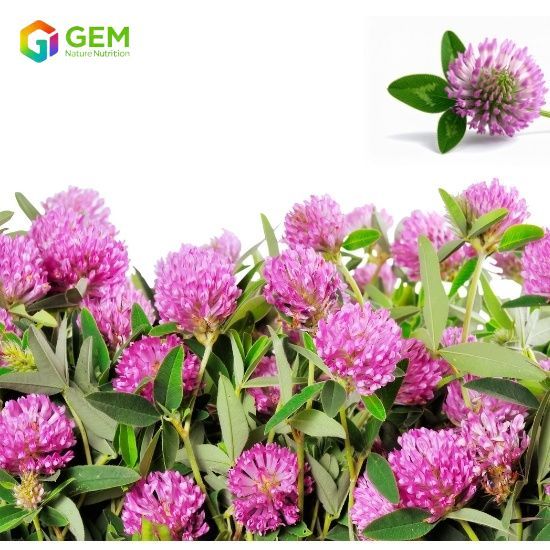
Red Clover Extract
Red Clover Extract bulk ingredient for B2B formulation sourcing. Request a specification sheet, batch COA, and documentation from GEM.
| 规格名称 | 规格值 |
|---|---|
| Latin Name | Trifolium pratense L. |
| Active Ingredients | Total Isoflavones |
| Total isoflavones | 40.0% |
| Shelf Life | 24 months |
| Solvents | Water and ethanol |
Red Clover Extract Details
Specification: 8%,10%,20%,40%,60% by HPLC
Mesh: 80mesh
Certificate: ISO22000; ISO9001; HACCP; Kosher; Halal
Packing: 25 kg/drum, 2 layers PE bags inside
Annual Production Capacity: More than 100 tons
Features: Non-GMO; ETO free; Non-Radiation; USP&EP Standard; Allergen (soy, gluten) free; Rich isoflavones.
Application: Pharmaceutical and medicine; Dietary supplement; Basic nutritional ingredients; Food and beverages; Food additives and Cosmetics; Feed and pet industry. etc.
Formulation context: Standardized isoflavone botanical ingredient commonly used in women’s-wellness formulations; finished-product claims require substantiation and target-market review.
Last updated: June 21, 2026
Product Introduction
What Is Red Clover Extract?
Red clover (Trifolium pratense), sometimes called purple clover or meadow clover, is a member of the Fabaceae (legume) family. Unlike many annual clovers, it is a short-lived perennial that builds a robust taproot, fixes nitrogen in the soil, and thrives on the temperate meadows and upland pastures where it has been harvested for generations. The whole aerial portion—leaves, stems, and the rounded crimson inflorescences—contains bioactive constituents, but commercial production concentrates on the flowering tops because they deliver the highest density of isoflavones.
In traditional herbal systems, red clover was prepared as teas, tinctures, and topical poultices. Modern nutraceutical manufacturing takes a different route: the dried flowering material is extracted and standardized so that formulators receive a consistent, measurable powder rather than a variable agricultural commodity. That standardization is what turns a forage crop into a reliable dietary ingredient.
The result is a brown, characteristically scented fine powder that blends predictably into capsules, tablets, sachets, and dry-mix beverage systems. Because the active fraction is quantified by HPLC, a buyer knows exactly what percentage of isoflavones sits in each kilogram—critical for regulatory documentation and for reproducible finished-product labels.
1. Premium Sourcing & Clean Extraction
Quality begins in the field. GEM sources red clover from partnered cultivation bases that follow documented agronomic protocols, giving every lot full traceability back to the growing season and region.
- Eco-Friendly Processing: To protect the delicate isoflavone fraction, the extraction uses only water and ethanol—food-grade solvents that are removed during concentration and drying. No hydrocarbon or chlorinated solvents enter the process.
- No Harsh Chemicals: The clean-label workflow leaves no toxic solvent residue in the finished red clover extract, supporting brands that market "clean" or "minimal processing" positioning.
2. The Power of Red Clover Isoflavones (Phytoestrogens)
The principal active constituents in red clover are its total isoflavones. GEM's red clover extract is standardized to a broad isoflavone profile that includes the aglycones and their glycosidic precursors:
- Biochanin A & Formononetin — the dominant isoflavones in red clover, present mostly as their sugar-bound forms (sissotrin and ononin)
- Daidzein & Genistein — additional aglycones that also occur as glycosides (daidzin and genistin)
- Sissotrin, Daidzin & Genistin — bound forms that the body can convert to free aglycones during digestion
This multi-component profile is one reason formulators choose red clover over single-isoflavone materials: the combined compounds behave differently in the body than any one molecule in isolation.
Active Compounds — The Red Clover Isoflavone Profile
A meaningful discussion of red clover extract has to start with its chemistry, because the isoflavone composition is what separates a standardized extract from ordinary clover hay.
Isoflavones are a subclass of flavonoids structurally related to the mammalian estrogen 17β-estradiol. In the plant they act as phytoalexins—defense compounds produced in response to stress—but in human nutrition they are studied for their estrogen-like activity. The four core aglycones in red clover are:
| Isoflavone (aglycone) | Role in the profile | Common glycosidic form |
|---|---|---|
| Biochanin A | Methylated precursor; precursor to genistein | Sissotrin |
| Formononetin | Most abundant red clover isoflavone | Ononin |
| Genistein | Formed via demethylation of biochanin A | Genistin |
| Daidzein | Converted in vivo to equol in some individuals | Daidzin |
Red clover extract is unusual among botanical sources because its dominant isoflavones are biochanin A and formononetin, whereas soy isoflavones are led by genistein and daidzein. That difference matters to formulators: the two raw materials deliver overlapping but distinct isoflavone assemblies, and they are frequently used together or as alternatives depending on the target product and regional preference. Brands building a soy-free isoflavone formula often specify red clover extract precisely because it provides the activity without soy-derived material—an advantage for allergen-sensitive and "soy-free" labels. For a soy-based alternative, see our Soy Isoflavones page.
How Red Clover Extract Works — Mode of Action
Understanding how red clover extract behaves at the cellular level helps procurement and R&D teams justify the ingredient on a specification sheet and a marketing brief alike.
Production Process & Quality Control
GEM's red clover extract manufacturing follows a linear, auditable workflow from raw herb to finished powder:
Red clover leaves & fllowers, Crushing&washing, Extraction(adding waterðanol), Concentration, Separation,Drying,Milling, Sieving&Mixing, Packing, Finished products.
Each stage is controlled to protect both the isoflavone content and the microbial and heavy-metal profile required by international buyers.
- Raw material control: Incoming flowering tops are identified botanically and checked for foreign matter, moisture, and pesticide history before they enter production.
- Standardized extraction: Water–ethanol extraction pulls the isoflavone fraction into solution; concentration and separation remove solvent and insoluble fiber.
- Spray or vacuum drying: The liquid extract is dried to a fine powder, then milled and sieved to the specified 80-mesh grade so it flows consistently on encapsulation and blending lines.
- In-process HPLC monitoring: Total isoflavones are tracked by HPLC throughout, locking the batch to its declared strength (8%, 10%, 20%, 40%, or 60%).
- Finished-goods testing: Every lot is released against the specification table below—appearance, loss on drying, ash, heavy metals, microbiology—before it is packed and documented with a COA.
The clean-label, non-irradiated, ETO-free workflow supports Kosher and Halal certification and aligns with the USP and EP reference standards cited in the product features. Buyers in the nutraceutical and food sectors receive full documentation for due diligence.
Red Clover Extract Specification
| Test Items | Specification | Test Methods |
|---|---|---|
| Appearance | Brown fine powder | Visual |
| Odor&Taste | Characteristic | Organoleptic |
| Total isoflavones | 40.0% | HPLC |
| Loss on drying | ≤5.0% | 2g/105°C/3hrs |
| Ash | ≤5.0% | 2g/600°C/3hrs |
| Mesh Size | NLT 95% Through 80 mesh | CP2020 |
| Heavy Metals | ≤10ppm | CP2020 |
| Lead(Pb) | ≤2ppm | AAS |
| Arsenic(As) | ≤2ppm | AFS |
| Mercury (Hg) | ≤1ppm | AFS |
| Total Plate Count | ≤1000cfu/g | GB 4789.2-2016 |
| Total Yeast &Mold | ≤100cfu/g | GB 4789.15-2016 |
| Coli group | ≤10cfu/g | GB 4789.3-2016 |
Remark: Above example spec is for red clover extract 40% total isoflavones by HPLC
The table above reflects the 40% total-isoflavone grade. Lower or higher strengths (8%, 10%, 20%, 60%) share the same contaminant limits and microbial standards; only the total-isoflavones line changes. Request the full Specification Sheet and COA for the exact grade you plan to purchase.
Application Fields
Red clover extract sits comfortably across several formulation categories because its isoflavones survive typical dry-processing and because the powder is easy to incorporate into tablets, capsules, sachets, and dry beverage mixes.
For women's-health stacks, red clover extract is frequently combined with Red Ginseng Extract for broader vitality support. In functional beverages, it pairs with Inulin, a soluble prebiotic fiber, or with Stevia in clean-label, plant-forward drink mixes.
Formulation Tips for Manufacturers
Practical experience from contract manufacturers and brand owners points to a few guidelines that smooth scale-up with red clover extract:
- Choose the right strength: The 40% and 60% grades let you hit a meaningful isoflavone dose in a smaller tablet or capsule; the 8–20% grades suit bulk powder blends and functional foods where the extract is a smaller part of the formula.
- Expect a characteristic taste: Red clover powder has a mild, herbaceous flavor. In chewables, stick packs, or beverages, a light flavor-mask (citrus, berry, or cocoa systems) improves palatability.
- Mind the flow: At 80 mesh the powder flows well, but like many botanical extracts it can pick up moisture. Keep it in sealed, low-humidity storage and consider a granulation step if you see feeding issues on high-speed capsule lines.
- Blend uniformly: Pre-blend the extract with a portion of the carrier (e.g., maltodextrin or microcrystalline cellulose) before the final mix to avoid streaking in low-dose formulas.
- Stability: Store away from heat and light. Under sealed, dry conditions the isoflavone content remains stable through normal shelf life; confirm exact storage and retest intervals on the COA.
6. Premium Feed & Pet Nutrition
Beyond human products, red clover extract is a traditional, nutrient-dense forage. Its standardized isoflavone content and protein fraction make the extract a consistent additive for premium livestock and pet-nutrition lines where formulators want reproducible botanical activity rather than variable field hay.
Market Context & Regulatory Status
The global market for botanical isoflavones is driven by two durable trends: aging populations in developed economies and a consumer shift toward plant-based, "clean" wellness products. Red clover extract competes and complements soy isoflavones in this space, and many brands stock both to serve soy-sensitive customers.
From a regulatory standpoint, red clover is generally recognized in many markets as a traditional food and herbal ingredient, but finished-product claims are tightly controlled:
GEM supplies the documentation B2B customers need for this due diligence—Specification Sheet, COA, and the relevant food-safety and religious-certification certificates. For background on another traditionally used botanical with a different regulatory profile, see our Red Ginseng Extract or the ginseng feature article in our news library.
B2B Buying & MOQ Guidance
Sourcing red clover extract in bulk rewards a little planning. A few pointers for procurement teams:
- Match strength to format: Tell your supplier the target finished dose and format first; that determines whether you need 8%, 20%, 40%, or 60% material and affects both cost and tablet size.
- Request samples early: A 50–100 g lab sample lets your R&D team verify flow, color, and compatibility before committing to a full lot.
- Confirm certifications up front: Kosher, Halal, ISO22000, ISO9001, and HACCP certificates are issued per qualified commercial order—request the current copies with your quotation.
- Plan for documentation: Budget time to review the COA and Specification Sheet against your own specs; GEM supports this during the order process.
- Discuss MOQ and lead time: GEM serves B2B customers with flexible order quantities and can advise on minimum order size, drum packing, and estimated lead time for your destination port. Reach out through the product inquiry form for a tailored quote.
Frequently Asked Questions
1. What is red clover extract and where does it come from?
Red clover extract is a powdered botanical produced from the flowering tops of Trifolium pratense L., a perennial legume. GEM supplies it as a standardized isoflavone powder for dietary supplement, food, and beverage manufacturers.
2. What are the main isoflavones in red clover extract?
The dominant compounds are biochanin A and formononetin, together with genistein and daidzein, present both as free aglycones and as glycosides (sissotrin, ononin, genistin, daidzin). This mixed profile is a key difference from soy isoflavones.
3. Which isoflavone strengths does GEM offer?
GEM supplies red clover extract standardized to 8%, 10%, 20%, 40%, and 60% total isoflavones by HPLC. The 40% grade is shown in the specification table; other strengths share the same contaminant and microbial limits.
4. How does red clover extract differ from soy isoflavones?
Red clover is led by biochanin A and formononetin, while soy is led by genistein and daidzein. Red clover is also naturally soy-free, making it suitable for allergen-sensitive and "soy-free" product lines. Compare the two on our Soy Isoflavones page.
5. Is red clover extract Non-GMO and allergen free?
Yes. The product is listed as Non-GMO, produced without irradiation, and free from soy and gluten allergens. It is also ETO free and manufactured to USP and EP reference standards.
6. What quality certificates does GEM hold for this ingredient?
The red clover extract line carries ISO22000, ISO9001, HACCP, Kosher, and Halal certificates. Current certificate copies are provided with qualified commercial orders.
7. What is a typical use level in a finished supplement?
Use levels depend on the isoflavone strength, the finished format, and the regulations of your target market. Many women's-health products are built around standardized daily isoflavone intakes; GEM can share formulation guidance, but final dosing and claims must be set by your regulatory team.
8. Can red clover extract be used in beverages and functional foods?
Yes. The water-dispersible powder blends into dry-mix shakes, instant beverages, and fortified foods. In flavored systems a light mask improves palatability. Confirm stability and labeling with your food-technologist and regulator.
10. What documents does GEM provide for B2B orders?
With quotations and qualified orders GEM provides a Specification Sheet, Certificate of Analysis (COA), and the relevant food-safety and religious-certification documents. MSDS can be supplied on request.
11. What is the minimum order quantity, and how long is lead time?
GEM supports B2B buyers with flexible order quantities and advises MOQ, drum packing, and estimated lead time based on grade and destination. Contact the product team through the inquiry form for a current quote.
12. Is red clover extract suitable for clean-label and vegan products?
Yes. The water–ethanol extraction leaves no harsh solvent residue, the material is plant-derived and suitable for vegan formulations, and it carries Kosher and Halal certification—strong fit for clean-label positioning.
Further Reading
- The Magic of Red Clover Extract — a dedicated feature article
- Soy Isoflavones — soy-based isoflavone alternative
- Red Ginseng Extract — botanical for vitality and women's-wellness stacks
- Inulin — soluble prebiotic fiber for functional beverage and food systems
- Stevia — clean-label natural sweetener for reduced-sugar formulations
- Ginseng, the Chinese Magic Herb — feature article on traditional botanical use