
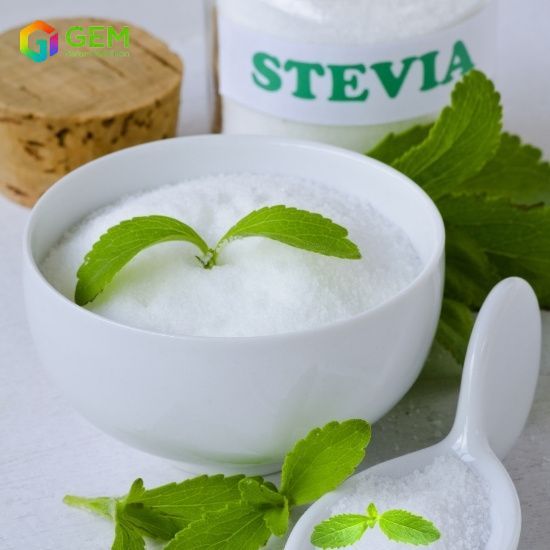
Stevia Extract
Stevia Extract bulk ingredient for B2B formulation sourcing. Request a specification sheet, batch COA, and documentation from GEM.
| 规格名称 | 规格值 |
|---|---|
| Appearance | White fine powder |
| Type | Sweetener |
| CAS No. | 57817-89-7 |
| Shelf Life | 24 months |
| Stock | Regular storage |
Stevia
Stevia extract is a high-intensity natural sweetener derived from the leaves of Stevia rebaudiana (Bertoni), a perennial herb in the Asteraceae family native to South America. Also widely known as stevia leaf extract, it delivers clean, sugar-like sweetness at a fraction of the calories, making it a cornerstone ingredient for global sugar-reduction programs. GEM supplies bulk Reb-A stevia and a full glycoside series — Stevioside, Rebaudioside A, D, M, and B — as water-soluble, allergen-free powders and granules for food, beverage, pharmaceutical, and nutraceutical manufacturers worldwide.
For brands navigating the shift away from added sugar, stevia extract offers a rare combination: plant origin, near-zero calories, and a taste profile that, in its higher-purity grades, approaches cane sugar more closely than any other natural alternative. This is why demand for bulk stevia extract continues to grow across food, beverage, and nutraceutical categories. This guide walks through what stevia extract is, why formulators choose it over sugar and artificial sweeteners, how it is made, the specification grades GEM offers, and the practical details that matter for B2B buying — from formulation tips to private-label and ODM support.
Stevia Leaf Extract Powder Details:
Specification:
- Stevia Glycosides 90%-95%;
- Stevioside STV 60%-95%;
- Reb-A RA40%-99%;
- And Reb-D, Reb-M, Reb-B series.
Certificate: ISO22000; ISO14001; ISO9001; FSSC22000; GMP; Kosher; Halal
Annual Production Capacity: More than 500 tons
Features: Natural sweetener from stevia leaf; Water-soluble; Allergen (soy, gluten) free; Pesticides free; Low fat; low calories; Sugar substitute; Bulk supply; Factory price.
Packing: 10kg/bag, 20kg/carton. Last updated: June 21, 2026
What is Stevia Extract?
Derived from the leaves of the Asteraceae herb family, Stevia is a premier natural sweetener and medical auxiliary agent. Known for its pure white appearance and clean, sweet profile, Stevia offers a stable, high-solubility solution for a wide range of applications.
The sweetness in stevia leaf comes not from sugar, but from a family of compounds called steviol glycosides — the sweet-tasting molecules attached to the steviol backbone. More than 40 distinct glycosides have been identified in the leaf, but the ones that matter most to formulators are Stevioside, Rebaudioside A (Reb-A), and the newer, better-tasting minor glycosides Reb-D, Reb-M, and Reb-B. Each differs in sweetness intensity, aftertaste, and solubility, which is why GEM offers them as separate, standardized grades. Every stevia extract lot is profiled so you know the exact glycoside composition before it reaches your line.
As a perfect alternative to sucrose, Stevia extract provides the familiar taste consumers love without the caloric burden, earning its reputation as the "Third Source of Sweetener" globally. The first two sources were caloric sugars (sucrose, fructose, glucose) and synthetic high-intensity sweeteners (aspartame, sucralose, saccharin). Stevia extract occupies a distinct third category: high-potency sweetness from a traditional botanical, with regulatory acceptance across most major markets.
The plant itself has a long history of use. Indigenous communities in Paraguay and Brazil used Stevia rebaudiana leaves to sweeten teas and medicines for centuries before the sweet compounds were isolated and characterized by scientists in the 20th century. Today, commercial cultivation spans Paraguay, China, Kenya, and other regions with suitable climate, and GEM sources and refines bulk stevia extract for international B2B customers under consistent quality systems.
The Steviol Glycoside Backbone
At the molecular level, every steviol glycoside shares the same ent-kaurene diterpene core — a steviol aglycone — decorated with sugar units (glucose, sophorose, or rhamnose) at different positions on the molecule. The number and arrangement of these sugar moieties determine both sweetness potency and taste quality. Generally, glycosides carrying more sugar units, such as Rebaudioside A and Reb-M, taste cleaner and register as sweeter, while Stevioside and Reb-C carry more pronounced bitter and licorice notes. Modern enzymatic and fermentation routes can attach additional glucose molecules to convert abundant Stevioside or Reb-A into the scarce, better-tasting Reb-D and Reb-M — the technology behind GEM's next-generation series. Understanding this structure–taste relationship is what lets formulators choose a grade, or a deliberate blend, matched to their exact sensory target rather than defaulting to the cheapest option on the shelf.
Why Choose Stevia Extract Instead of Sugar?
High Potency, Low Calorie: Stevia extract is roughly 200-450 times sweeter than cane sugar, yet contains only 1/300th of the calories.
Superior Stability: It is highly soluble in both water and alcohol, heat-stable and resistant to molding, making it ideal for diverse manufacturing environments.
Clean Label Appeal: With no peculiar aftertaste or odors, it maintains the integrity of your original formula's flavor profile.
Beyond these three pillars, the practical case for stevia extract becomes clearer when you set it side by side with the alternatives a formulator might consider. The table below compares stevia extract (high-purity Reb-A) with sucrose and a common artificial sweetener across the attributes that drive real-world product decisions.
| Attribute | Stevia extract (Reb-A) | Sucrose (cane sugar) | Aspartame (artificial) |
|---|---|---|---|
| Relative sweetness (× sucrose) | 200–450× | 1× | ~200× |
| Caloric contribution | Negligible (~0 kcal/g) | 4 kcal/g | Minimal in use, but synthetic |
| Heat stability | High — stable in baking, retort, UHT | High | Low — degrades with heat |
| Impact on blood glucose | None | High (high GI) | None |
| Plant / natural origin | Yes (Stevia rebaudiana) | Yes, but caloric | No — synthetic |
| Clean-label positioning | Strong | Neutral | Weak |
One nuance worth noting: because stevia extract is a high-potency sweetener, it is almost never used alone in a finished product. The most successful reduced-sugar launches pair it with a bulk sweetener or prebiotic fiber to restore the body, mouthfeel, and browning that sucrose contributes. Erythritol, polydextrose, inulin, and allulose are common partners; each shifts the sweetness curve and masks minor aftertaste differently. GEM's role as a multi-ingredient supplier means these partners can be sourced, blended, and quality-controlled together rather than managed across several vendors — a meaningful advantage for ODM programs described later in this guide.
A Nutritional Powerhouse
Beyond its sweetening power, stevia extract is rich in vital nutrients. It contains 14 essential amino acids and over 10 trace elements, including: Zinc, Iron, Selenium, Chromium, Manganese, and more.
The non-cariogenic nature of stevia extract deserves emphasis for oral-care and confectionery applications. Unlike fermentable sugars that feed Streptococcus mutans and contribute to enamel demineralization, steviol glycosides are not metabolized by oral bacteria, so they do not drive acid production in the mouth. This is why sugar-free chewing gum and children's oral-care products frequently rely on stevia leaf extract as the primary sweetener.
Regulatory Standing of Stevia Extract
A natural origin alone does not support market access; regulatory clarity is what lets formulators scale with confidence. The good news is that high-purity stevia extract enjoys broad global acceptance, built on decades of safety review.
United States — FDA GRAS. In the United States, high-purity steviol glycosides are recognized as Generally Recognized as Safe (GRAS) for use as general-purpose sweeteners in foods and beverages. The FDA has issued favorable responses to GRAS notices covering Reb-A and other major glycosides, clearing the path for use in everything from soft drinks to yogurts and baked goods. Brands should confirm the specific glycoside grade and intended use level against the relevant GRAS notice for their application.
European Union — EFSA and E 960. The European Food Safety Authority delivered a positive scientific opinion on steviol glycosides, and the EU authorized them as food additive E 960. They are permitted across a defined range of food and beverage categories at specified maximum levels. GEM's Kosher- and Halal-certified grades support manufacturers serving both conventional and faith-based European markets.
International — JECFA ADI. The Joint FAO/WHO Expert Committee on Food Additives (JECFA) established an Acceptable Daily Intake (ADI) of 4 mg/kg body weight per day, expressed as steviol. This global safety benchmark underpins approvals in dozens of countries outside the US and EU, including many in Asia-Pacific and Latin America.
Additional Regional Markets
Beyond the US, EU, and JECFA benchmark, stevia extract is authorized in a growing list of jurisdictions. In Brazil, ANVISA permits steviol glycosides following JECFA-derived principles. China's National Health Commission lists steviol glycosides as an approved food additive (GB 8270, the same standard referenced in GEM's Loss-on-Drying test method). Canada's Health Canada and Australia–New Zealand's FSANZ both permit defined uses across specified food categories. Japan has a long history of domestic use and its own established monographs. Each market sets its own maximum use levels by category, so application-specific limits must always be checked against local law before launch.
How JECFA and EFSA Assess Safety
Practical note for B2B buyers. Approved uses, maximum levels, and permitted food categories vary by jurisdiction. GEM supplies specification documentation to support your regulatory submission, but final compliance — including label claims — remains the responsibility of the brand owner in each market. Our technical team can point you to the relevant grade and certificates for your region.
Stevia Extract Product Specification:
The table below defines GEM's standard food-grade stevia extract specification. Values are confirmed by HPLC and standard methods on each batch.
| Testing Item | Specification | Test Method |
|---|---|---|
| Appearance | White fine powder | Visual |
| Total Steviol Glycosides(% dry basis) | ≥99 | HPLC |
| Rebaudioside A % | ≥98 | HPLC |
| Loss on Drying | ≤6.0 | GB 8270-2014 |
| Ash | ≤1.0 | GB(1g/580C/2hrs) |
| Sweetness times | ≥430 | |
| PH (1% solution) | 5.5-7.0 | |
| Specific Optical Rotation | -30o~-38o | GB |
| Specific Absorbance | ≤0. 1 | GB |
| Lead (ppm) | ≤0.5 | CP |
| Arsenic(ppm) | ≤0.1 | CP |
| Cadmium(ppm) | ≤0.1 | CP |
| Mercury(ppm) | ≤0.1 | CP |
| Total Plate Count(cfu/g) | ≤1000 | CP/USP |
| Coliforms | Negative | CP/USP |
| Yeast&Mold(cfu/g) | Negative | CP/USP |
| Salmonella(cfu/g) | Negative | CP/USP |
| Staphylococcus(cfu/g) | Negative | CP/USP |
Remark: Send us email for requesting other spec.
Production Process:
Stevia leaves-Soaking in water-Flocculation and precipitation of suspended matter-Filtration by plate and frame-Concentration by vacuum assisted evaporation-Adsorption in a macroporous absorbent resin-Remove the impurity by acid elution and basic elution-Release the steviol glycosides by ethanol elution-De-salt by cation exchange resin-De-color by anion exchange resin-Concentration by vacuum assisted evaporation-Further remove the impurity by refining resin-Concentration by vacuum assisted evaporation-Spray drying-Packing
The process above is a water-based extraction and purification route — no organic solvents remain in the finished powder beyond the controlled ethanol elution step, which is fully removed before spray drying. Macroporous resin adsorption and ion-exchange refining are what allow GEM to push total steviol glycosides to ≥99% and Rebaudioside A to ≥98% in the top grade, while keeping heavy metals, microbiology, and color within tight limits. For buyers, this translates into batch-to-batch consistency: the same sweetness, solubility, and sensory profile order after order.
Different Specifications of GEM Stevia
We offer a comprehensive range of stevia extract grades, meticulously refined to meet diverse formulation needs from cost-effective sweeteners to premium, sugar-like taste profiles.
1. Steviol Glycosides Series (SG)
The Industry Standard
Our SG 90% is our most versatile and widely used specification. Available as a white or light-yellow powder/granule, it provides a reliable, lasting sweetness with a signature cool finish.
2. Stevioside Series (STV)
High-Potency Sweetness
Positioned just below the RA series in flavor profile, STV 90% offers a powerful sweetness approximately 270 times that of sucrose, making it an efficient choice for high-volume production.
3. Rebaudioside-A Series (RA)
The Peak of Extraction Technology
- RA 98%: Produced to meet stringent FDA standards, this specification delivers a fresh, lasting sweetness roughly 450 times that of sucrose.
- RA 99%: Our core RA product. By using advanced extraction technology to minimize Rebaudioside C (RC), we have achieved a flavor profile that is nearly indistinguishable from cane sugar. It is the premier choice for top-grade pharmaceuticals and gourmet food products.
4. Rebaudioside-D & M Series (RD & RM)
The Next Generation of Taste
- Reb-D: A rare and premium glycoside. Because of its low natural concentration in the leaf, Reb-D is reserved for high-end formulations where a superior, clean sweet taste is required.
- Reb-M: The result of extensive research and development, Reb-M offers an even more refined taste than Reb-D. It is rapidly becoming the gold standard for brands seeking the ultimate sugar-free experience.
5. Rebaudioside-B Series (RB)
The Flavor Harmonizer
While lower in sheer sweetness, Reb-B plays a critical role in complex formulas. It acts as a natural debittering agent, smoothing out the flavor profile and adding a pleasant, subtle aroma to finished products.
Selecting a Grade by Application
A useful rule of thumb is that the more exposed the sweetness, the higher the grade you should choose. Beverages and dairy, where off-notes are easily detected by consumers, favor RA 98–99% or Reb-M. Bakery and tabletop blends, where other flavors and bulk sweeteners mask minor notes, perform well on cost-efficient SG 90% or STV 90%. Pharmaceutical syrups and premium nutraceuticals default to RA 99% or Reb-D/Reb-M blends. When both budget and taste matter, a blended approach — RA 99% softened with Reb-B, or SG 90% lifted with a touch of Reb-A — delivers a defensible sensory result at a controlled cost.
Choosing between these grades is fundamentally a formulation economics decision. A cost-sensitive beverage may perform well on SG 90% or STV 90%, while a premium protein shake or pharmaceutical syrup benefits from RA 99% or a Reb-D/Reb-M blend to minimize licorice notes. Many GEM customers blend stevia extract grades — for example, RA 99% with a touch of RB — to hit both taste and budget targets. Our technical team can help you map a grade to your product matrix.
Key Applications of Stevia Leaves Extract
Versatile Industry Applications
Stevia extract's safety and stability make it a preferred ingredient across multiple sectors:
- Food & Beverage: Ideal for sugar-free drinks, snacks, and dairy.
- Pharmaceuticals: Used as a non-toxic auxiliary agent and sweetener for medicines.
- Cosmetics: A natural additive for specialized skincare and oral care.
- Wine & Spirits: Enhances flavor profiles without adding fermentable sugars.
Formulation Tips for Food & Beverage
Getting the most from stevia extract is as much craft as chemistry. A few practical guidelines help new users avoid the common pitfalls:
Start with the right grade. Higher-purity stevia extract grades (Reb-A, Reb-D, Reb-M) carry less of the licorice-like aftertaste associated with Stevioside and Reb-C. If your first pilot tastes "off," move up the grade ladder before reformulating the whole recipe.
Balance the sweetness curve. Stevia extract's sweetness builds and lingers differently from sucrose. Blending 5–20% of a bulk sweetener (erythritol, inulin, or polydextrose) rounds the profile and reduces the characteristic cooling sensation of high-intensity glycosides.
Mind the pH. Per the specification, GEM stevia extract performs within a pH range of 5.5–7.0 at 1% solution. Acidic beverages (carbonates, juices) stay stable, but extreme pH can affect perceived taste — pilot within your final product pH.
Leverage heat stability. Unlike aspartame, stevia extract survives baking, retort, and UHT. You can add it early in the process rather than post-processing, which simplifies line integration.
Mask minor off-notes with flavor modulators. A small amount of vanilla, citrus oil, or Reb-B (our "flavor harmonizer" grade) smooths the finish in sensitive applications like dairy and ready-to-drink teas.
Dose by equivalency, not by weight. At 200–450× sucrose, you need only milligrams per serving. Build your master batch as a liquid concentrate or pre-blend to ensure even distribution across large production runs.
Formulation Case Studies by Category
Generic tips only go so far; the practical value of stevia extract shows up in the specifics of each product matrix. The following category examples illustrate how GEM customers match a grade and a support system to a real finished product.
Beverages & Ready-to-Drink (RTD)
Carbonated soft drinks, flavored waters, and RTD teas are the largest global use of bulk stevia extract. In a typical cola or citrus formulation, a Reb-A 99% or Reb-M grade is dosed at a few milligrams per liter, often with 3–8% erythritol to round the cooling finish. Acidic pH (2.5–4.0) is well within stability, and the heat of hot-fill or tunnel pasteurization does not degrade the glycosides. For sensitive tea or dairy-based drinks, a small amount of Reb-B or vanilla modulates the aftertaste. GEM supplies the grade as a spray-dried powder that dissolves cleanly in cold make-up water, simplifying line integration.
Bakery & Confectionery
Cakes, biscuits, and sugar-free chocolates rely on stevia extract for heat stability and non-cariogenic sweetness. Because removing sucrose eliminates structure, bulk, and browning, bakers pair stevia extract with inulin or polydextrose (often 15–40% of the dry matrix) to restore crumb softness and Maillard color. In confectionery, stevia extract survives cooking and enrobing temperatures that would destroy aspartame, and its non-fermentable profile keeps products suitable for oral-care positioning. SG 90% or STV 90% are common cost-efficient choices here, with RA 99% reserved for premium SKUs.
Dairy & Plant-Based Alternatives
Yogurts, flavored milk, and oat or soy drinks use stevia extract to cut added sugar without the metallic note some consumers associate with synthetic sweeteners. The ingredient survives fermentation and UHT or retort processing. A frequent approach is a 60–80% sugar reduction via stevia extract plus a prebiotic fiber such as Inulin or Xylo-oligosaccharide, which adds body and a gut-health claim angle. Pilot at your final pH and protein load, as high-protein systems can subtly shift perceived sweetness.
Pharmaceuticals & Nutraceuticals
In syrups, chewable tablets, and powdered stick packs, stevia extract serves as a non-toxic taste-masking and sweetening auxiliary. RA 99% is preferred for its clean profile near cane sugar, and Reb-M where the ultimate sugar-free experience is required. Because these formats often pair with active ingredients that carry bitter notes, GEM's Reb-B "flavor harmonizer" grade is sometimes blended in at 2–5% to smooth the finish. All grades ship with the Kosher, Halal, and ISO/FSSC documentation needed for regulated markets.
Private Label & ODM Guidance
Stevia extract is rarely the only ingredient in a finished product, and GEM supports brand owners who want more than a raw material. Our private-label and ODM services cover custom blends, granulation for improved flow and dissolution, and tailored Reb-A ratios matched to your sensory and cost targets.
For multi-ingredient programs, sourcing from a single supplier reduces paperwork, lead time, and quality risk. Beyond stevia, GEM's natural plant extract portfolio spans Red Clover Extract, soy isoflavones, ginseng, reishi mushroom extract, and lion's mane — enabling combined ODM projects from one qualified manufacturer. You can read more about GEM's botanical expertise in our profiles of Red Clover Extract and Ginseng, the Chinese magic herb.
Typical ODM engagement steps: (1) share your target application, sweetness level, and budget; (2) GEM proposes a grade or blend with samples; (3) you pilot and refine; (4) we lock the spec, certificates, and packing for recurring production. Certificates available include ISO22000, ISO14001, ISO9001, FSSC22000, GMP, Kosher, and Halal.
Granulation & Blend Design
Two technical services add the most value for brand owners. Granulation converts fine powder into free-flowing granules or agglomerates with controlled dissolution — improving dosability on existing lines and reducing dust during handling. GEM offers spray-granulation and dry-granulation options tuned to your mixer and dissolve-speed needs. Blend design pairs stevia extract with bulking fibers and complementary sweeteners into a single pre-mix, so your plant receives one SKU instead of five. Common blend partners include Inulin, Xylo-oligosaccharide, and soy isoflavones or reishi mushroom extract where a functional-ingredient story is part of the positioning. Each blend is documented with its own specification and COA, so your QC team validates one qualified material rather than auditing several separately.
B2B Buying & MOQ Guidance
Procuring stevia extract at scale is straightforward when you know what to request. GEM's annual production capacity exceeds 500 tons, and the standard packing is 10 kg/bag inside a 20 kg/carton — a format that suits both trial orders and full container loads.
Samples and documentation. Before committing to volume, request a sample pouch, the full Specification Sheet, COA (Certificate of Analysis), and MSDS. These let your QC team verify glycoside profile, microbial limits, and heavy metals against your incoming specification.
MOQ and lead time. Minimum order quantities are flexible and calibrated to your stage — from laboratory samples for formulation through commercial container shipments. Lead times depend on grade and order size; Reb-A and standard SG grades are typically available fastest. Contact GEM with your target spec and volume for a quote and current lead time.
Quality assurance for recurring supply. Because the production process is standardized and resin-refined, GEM can hold a fixed sensory and analytical profile for your stevia extract supply across seasons and batches. For buyers running private label or contract manufacturing, this consistency protects your finished-product taste from one production cycle to the next.
Logistics. GEM supports international B2B shipping with the documentation required for food-ingredient import in major markets. Discuss Incoterms, port of destination, and any specific certificate requirements (such as organic — note GEM stevia is not currently organic-certified, see FAQ) when you request a quotation.
Frequently Asked Questions
1. Which is the best seller spec for stevia leaf extract?
Hot specs: Stevia Glycosides 90% and 95%.
2. Is there any side effects for stevia?
It is safe under normal usage. Individuals with specific medical conditions should consult a qualified healthcare professional before use.
3. Do you have organic stevia?
GEM Stevia currently does not carry organic certification. If your formulation requires certified organic stevia, we can introduce you to qualified partner facilities.
4. What is the difference between Reb-A, Reb-D, and Reb-M stevia?
All three are steviol glycosides, but they differ in taste and rarity. Reb-A is the established high-purity standard (up to 99%), roughly 450× sweeter than sugar with minimal aftertaste. Reb-D and Reb-M are minor glycosides found in tiny amounts in the leaf; they deliver an even cleaner, more sugar-like taste and are used in premium formulations where taste is paramount. GEM supplies all three as separate grades.
5. How sweet is stevia extract compared with sugar?
Depending on grade, stevia extract is about 200–450 times sweeter than sucrose. Our top Reb-A 99% specification reaches roughly 450×, and the product specification confirms a sweetness of ≥430 times sucrose. Because potency is so high, finished products use only milligrams per serving.
6. Is stevia extract heat stable for baking and beverages?
Yes. Stevia extract is heat-stable and suitable for baking, retort, UHT, and hot-fill processes — a key advantage over heat-sensitive artificial sweeteners like aspartame. It is also water-soluble and resistant to molding, which simplifies line integration across food and beverage manufacturing.
7. What regulatory approvals does stevia extract have?
In the United States, high-purity steviol glycosides are FDA GRAS for general-purpose sweetening. In the EU they are authorized as food additive E 960 following a positive EFSA opinion. Globally, JECFA set an ADI of 4 mg/kg body weight/day (as steviol). Approved uses and maximum levels vary by market, so confirm specifics for your target region.
9. What is the minimum order quantity and lead time for bulk stevia?
MOQ is flexible — from sample quantities for formulation through full commercial shipments. Lead time depends on grade and volume; standard SG and Reb-A grades are typically the fastest. Contact GEM with your spec and volume for a current quote and lead time.
10. Do you provide COA, specification sheet, and samples?
Yes. GEM provides Specification Sheet, COA, and MSDS on request, along with Kosher, Halal, and ISO/FSSC certificates for qualified commercial orders. Sample pouches are available so your QC team can validate the material before volume commitment.
11. What packaging and shelf life do you offer?
Standard packing is 10 kg/bag, 20 kg/carton. Store in a cool, dry place sealed from moisture. Specific shelf-life guidance can be confirmed on the Specification Sheet supplied with your order.
12. How soluble is stevia extract, and how should I dissolve it?
GEM stevia extract is water-soluble and dissolves cleanly in cold or warm water. For even distribution across large runs, prepare a liquid concentrate or pre-blend rather than adding powder directly, and keep the inner liner closed to avoid clumping from humidity. Most beverage and dairy lines disperse it without special equipment.
13. Can stevia extract be blended with other sweeteners?
Yes. It is frequently combined with erythritol, allulose, polydextrose, monk fruit, or prebiotic fibers such as inulin and xylo-oligosaccharide to restore body and round the sweetness curve. GEM supports customized blended pre-mixes through its ODM service, so you receive one qualified SKU instead of managing several raw materials separately.
14. What is the shelf life and how should it be stored?
Store sealed in a cool, dry place away from moisture, heat, and strong odors; keep the inner bag closed between uses. Specific shelf-life guidance is confirmed on the Specification Sheet supplied with your order. Proper storage preserves sweetness, solubility, and microbial status across the stated period.