
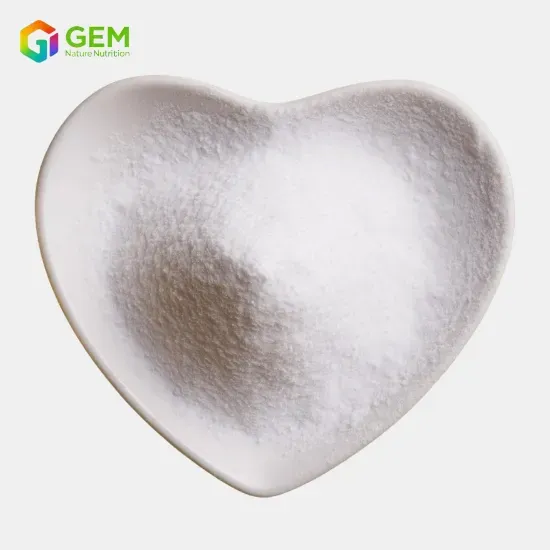
L-Ornithine Monohydrochloride
L-Ornithine Monohydrochloride bulk ingredient for B2B formulation sourcing. Request a specification sheet, batch COA, and documentation from GEM.
| 规格名称 | 规格值 |
|---|---|
| Assay | 99–101% HPLC |
| CAS No. | 3184-13-2 |
| Appearance | White crystals or crystalline powder |
| Shelf Life | 24 months |
| Packing | 25 kg/drum |
L-Ornithine Monohydrochloride
L-Ornithine Monohydrochloride is the hydrochloride salt of the amino acid L-ornithine, and GEM supplies it as a high-purity bulk powder for B2B supplement manufacturers, nutraceutical brands, and functional-food producers worldwide.
L-Ornithine Monohydrochloride is a water-soluble amino acid derivative for liver-support, sports-nutrition, and ready-to-drink beverage applications. The HCl salt dissolves far more readily than the free base, so GEM (gemnn.com) supplies it in 25 kg drums with full COA documentation on every batch.
Quick View — L-Ornithine Monohydrochloride
- Product Name: L-Ornithine Monohydrochloride
- Specification: 99% HPLC (assay 99%–101%)
- Other Names: L-Ornithine hydrochloride;H-Orn-OH.HCl
- Molecular Formula: C5H13N2O2
- Packing: 25 kg/drum
- Last updated: June 21, 2026
- Storage: Stored in closed containers in a cool, dry, well-ventilated area.
- Certificates: ISO22000, FSSC22000, Kosher, Halal (available for qualified B2B orders)
As an established amino acid supplier, GEM also offers complementary actives such as L-Arginine and L-Ornithine L-Aspartate, backed by verified chiral purity and batch-level traceability for easy qualification.
Source & Chemistry
The active moiety is L-ornithine, a basic amino acid with the molecular formula C5H13N2O2, supplied as a crystalline salt that is easier to handle than the free base.
Ornithine HCl vs. Free-Base Ornithine
Free-base L-ornithine is hygroscopic and poorly soluble, complicating large-scale formulation. The HCl salt resolves both problems: it forms white crystals or a crystalline powder, dissolves readily in water, and delivers a consistent dose of the L-ornithine cation, making it the practical default for nutraceutical applications.
L-Ornithine Monohydrochloride vs. L-Ornithine L-Aspartate
Buyers often compare ornithine monohydrochloride with L-Ornithine L-Aspartate, which pairs ornithine with L-aspartate and is used where the aspartate moiety adds metabolic activity. The monohydrochloride delivers ornithine in its purest, most concentrated salt form without an added amino-acid partner — the better choice when a formula calls specifically for ornithine content or maximum solubility. Both share the same underlying mechanism; the difference is the counter-ion and the resulting application fit.
Position in the Citrulline–Arginine–Ornithine Cycle
Ornithine is linked metabolically to arginine and citrulline: arginine is converted to ornithine and urea by arginase, ornithine becomes citrulline, and citrulline is rebuilt into arginine. This is why ornithine is formulated alongside L-Arginine and L-Citrulline DL-Malate in sports-nutrition products, where together they support nitric-oxide pathways and ammonia recycling during intense exercise.
L-Ornithine Monohydrochloride Specification
GEM supplies L-Ornithine Monohydrochloride to a tight specification confirmed by HPLC and supported by full in-house and third-party testing. The table below lists every release test item and its acceptance limit.
| Testing Item | Specification |
|---|---|
| Appearance | White crystals or crystalline powder |
| Assay | 99%~101% |
| Specific rotation | +23.0°~+25.0° |
| Light Transmittance | ≥ 98.0% |
| PH | 5.0-6.0 |
| Loss on drying(%) | ≤ 0.2% |
| Residue on ignition(%) | ≤ 0.1% |
| Ammonium(%) | ≤ 0.02% |
| Sulfate(%) | ≤ 0.02% |
| Heavy Metals | ≤ 10ppm |
| Iron(Fe) | ≤ 10ppm |
| Arsenic | ≤ 0.5ppm |
| Total plate counts | ≤1000cfu/g |
| Yeast and Moulds | ≤100cfu/g |
| Salmonella | Absence |
| E.coli | Absence |
| Other amino acids | Chromatographically not detectable |
The specification reflects food- and pharmaceutical-grade expectations: a 99%–101% assay band, a specific-rotation window confirming the correct L-chirality, high light transmittance for solution clarity, and strict microbiological and heavy-metal limits. The "chromatographically not detectable" requirement for other amino acids confirms a clean, single-active profile.
Application Fields
L-Ornithine Monohydrochloride serves a range of finished-product categories summarized in the table below.
Beyond these core fields, ornithine monohydrochloride is also incorporated into EAA complexes, where it complements L-Leucine and other essential amino acids for muscle-recovery positioning. Its clean profile and solubility make it a flexible building block for powder stick-packs and bottled beverages alike.
Production & Quality
Manufacturing and Sourcing
The ingredient is produced and sourced through qualified supply partners under controlled manufacturing conditions, then packaged in 25 kg drums suited to bulk B2B handling. GEM performs supplier qualification, incoming-material verification, and retention-sample management.
Certifications
For qualified B2B commercial orders, GEM can provide ISO22000, FSSC22000, Kosher, and Halal certificates. These food-safety and dietary credentials help brands meet retailer, regulator, and end-consumer requirements across global markets.
Storage and Handling
Stored in closed containers in a cool, dry, well-ventilated area, the material maintains its specification through its stated shelf life. Keep drums sealed until use and avoid humidity to preserve free-flowing crystalline quality.
Traceability and Documentation
Each batch carries full documentation — COA, specification conformance, and certificate support — so manufacturers satisfy their own quality systems and pass audits with confidence. Traceability from source to drum is a core part of GEM's B2B supply commitment.
Frequently Asked Questions
1. Why choose the HCl salt over free-base L-ornithine?
The HCl salt form provides superior solubility in aqueous systems, making it easier to formulate in capsules, tablets, and liquid supplements. It is also more stable and less hygroscopic than the free base, which simplifies storage and processing.
2. What assay range does GEM support?
GEM supplies 99–101% HPLC with chiral purity confirmed and full batch COA documentation. The specific-rotation window of +23.0° to +25.0° independently verifies the correct L-form.
4. What certifications are available?
ISO22000, FSSC22000, Kosher, and Halal certificates available for qualified B2B commercial orders. Buyers should confirm certificate availability at the time of quotation, as scope can vary by lot and region.
6. What is the difference between L-Ornithine Monohydrochloride and L-Ornithine L-Aspartate?
Both contain the same ornithine active, but the monohydrochloride is the pure HCl salt, while L-Ornithine L-Aspartate pairs ornithine with L-aspartate. Choose the HCl form when you need concentrated, highly soluble ornithine without an added amino-acid partner.
7. How should the material be stored?
Store in closed containers in a cool, dry, well-ventilated area, away from moisture. Keep drums sealed until use to preserve the free-flowing crystalline quality and the stated shelf life.
8. Can it be used in ready-to-drink beverages?
Yes. The water-soluble HCl salt is suitable for ready-to-drink amino-acid drinks and clear liquid formats, thanks to its high solubility and the ≥98.0% light-transmittance specification that supports solution clarity.
9. Is the product free from other amino-acid impurities?
Yes. The specification requires that other amino acids be "chromatographically not detectable," confirming a clean, single-active profile suitable for precise formulation.
10. How do I request a quote or sample?
Procurement teams can contact GEM (gemnn.com) to request specifications, certificates, pricing, and sample quantities for L-Ornithine Monohydrochloride. Volume and certification options are confirmed during the quotation process.
Further Reading
Explore related amino-acid ingredients and application resources from GEM:
- L-Ornithine L-Aspartate — the aspartate salt of ornithine for liver-health formulations
- L-Arginine — urea-cycle and nitric-oxide partner amino acid
- L-Arginine Hydrochloride — HCl salt form of arginine
- L-Citrulline DL-Malate — sports-nutrition cycling partner
- L-Leucine — essential amino acid for EAA and BCAA blends
- Pea Protein Powder — plant-protein base for amino-acid formulations