
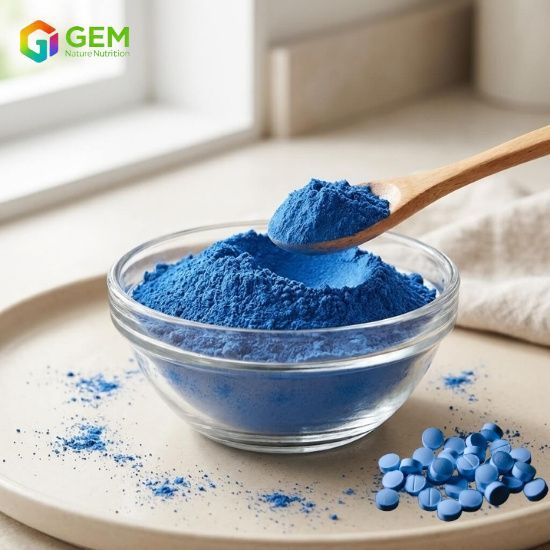
Phycocyanin
Phycocyanin bulk ingredient for B2B formulation sourcing. Request a specification sheet, batch COA, and documentation from GEM.
| 规格名称 | 规格值 |
|---|---|
| Other Name | Blue spirulina; Spirulina extract |
| Forms | Powder; Tablets |
| Color Value | E3, E6, E18, E25, E40 |
| Shelf Life | 24 months |
| Solvents | Water |
Phycocyanin
Phycocyanin is a nutrient-dense functional protein and natural blue pigment extracted from edible spirulina (Arthrospira platensis), and GEM supplies high-purity phycocyanin powder and tablet forms at color values E3–E40 for food, supplement, and cosmetic manufacturers worldwide.
As a leading B2B ingredient supplier, GEM (gemnn.com) offers phycocyanin produced through an eco-friendly pure-water extraction and advanced membrane separation process. This spirulina blue pigment delivers brilliant, stable blue coloration while doubling as a protein-rich functional ingredient. Below is a quick-reference summary of the material we supply, followed by detailed specifications, sourcing background, and application guidance for formulators.
Quick View
Color Value: E3, E6, E18, E25, E40
Certificate: FSSC22000; ISO14001; ISO9001; GMP; HACCP; Kosher; Halal
Annual Production Capacity: More than 100 tons
Forms: Powder & Tablets (250mg/tablet; 500mg/tablet; 1g/tablet)
Features: Bright color; Non-GMO; Non-ETO; Non-Radiation; USP&EP Standard; Allergen (soy, gluten) free; Beautiful blue pigment.
Application: Pharmaceutical and medicine; Dietary supplement; Basic nutritional ingredients; Food and beverages; Food additives and Cosmetics; Nature pigment, etc.
Last updated: June 21, 2026
What Is Phycocyanin?
Phycocyanin is a premium, nutrient-dense functional protein extracted from edible spirulina (Arthrospira platensis). GEM Nature offers two kinds of forms: phycocyanin powder and phycocyanin tablets, both suitable for industrial formulation across food, nutraceutical, and cosmetic sectors.
At GEM, we manufacture phycocyanin by extracting and using an eco-friendly pure water extraction method and refine it via advanced membrane separation technology. This process ensures the protein remains bioactive, pure, and free from chemical solvents. The result is a clean-label ingredient that meets the expectations of modern food, nutraceutical, and cosmetic brands seeking recognizable, naturally derived components.
Biochemically, phycocyanin is a phycobiliprotein — a class of light-harvesting proteins found in cyanobacteria and certain algae. Its distinctive cobalt-blue color comes from a covalently bound phycobilin chromophore. Because very few naturally occurring substances produce a true blue hue, phycocyanin occupies a unique position among natural colorants. For formulators seeking to replace synthetic blue dyes, this spirulina blue pigment is one of the only globally recognized options derived from a renewable biological source.
The global shift away from artificial colors has accelerated adoption of phycocyanin across North America, Europe, and Asia-Pacific markets, where regulators and retailers increasingly favor naturally sourced additives. As consumer labels move toward shorter, more legible ingredient lists, demand for a dependable natural blue colorant continues to grow.
1. A Rare, Clean-Label Natural Colorant
Phycocyanin is one of the very few natural blue pigments available globally. It offers a "Clean Label" solution for brands looking to replace synthetic dyes:
- Appearance: Brilliant, natural sky-blue color
- Solubility: Highly water-soluble, making it perfect for liquid applications
- Safety: Non-toxic, eco-friendly, and derived from sustainable algae
Unlike petroleum-derived color additives, phycocyanin aligns with consumer demand for recognizable, plant- and algae-based ingredients. Its water solubility makes it especially valuable in beverages, where dispersion and clarity matter.
Source & Botany
Phycocyanin is sourced from Arthrospira platensis, the cultivated blue-green algae more commonly known as spirulina. Spirulina is a filamentous cyanobacterium that thrives in warm, alkaline, and highly saline waters. Commercial cultivation takes place in controlled ponds and photobioreactors, where sunlight, carbon dioxide, and mineral nutrients drive rapid biomass growth.
Several characteristics make spirulina an ideal source of natural blue pigment:
- High phycocyanin content: The algae concentrate phycobiliproteins in their light-harvesting complexes, yielding a pigment-rich biomass.
- Rapid, renewable growth: Spirulina doubles its biomass in roughly 24–48 hours under optimal conditions, supporting a sustainable supply chain.
- Nutrient density: Beyond pigment, the biomass contains protein, essential amino acids, and micronutrients, reinforcing the ingredient's functional profile.
Because the pigment is extracted from a whole-food algae rather than synthesized chemically, phycocyanin qualifies as a natural blue colorant under clean-label positioning. GEM selects cultivation partners and raw-material lots for consistent pigment concentration, which is reflected in the standardized color values (E3–E40) we offer. Strain selection and gentle downstream processing determine whether the final powder retains its brilliant hue or degrades to a duller tone, so lot-to-lot standardization is a discipline we maintain across every grade.
Buyers evaluating related algae-based ingredients may also find our spirulina and chlorella protein powders relevant for combined formulations, particularly where a protein-forward label claim complements the blue pigment.
Phycocyanin Specification
The following specification defines the quality parameters for our standard phycocyanin powder. Every lot is tested against these criteria before release. The reference color value shown is E 18.0; other grades (E3, E6, E25, E40) are available on request.
| Test Item | Specification | Test Methods |
|---|---|---|
| Appearance | Fine blue powder | Visual |
| Taste and Odor | Slightly fishy and odorless | Organ |
| Color Value | E 18.0 | GB1886.309-2020 |
| Moisture | ≤7% | GB 5009.3 |
| Lead | ≤1.0mg/kg | GB 5009.12 |
| Arsenic | ≤0.5mg/kg | GB 5009.11 |
| Mercury | ≤0.1mg/kg | GB 5009.17 |
| Cadmium | ≤0.2mg/kg | GB 5009.15 |
| Total Plate Count | ≤10000CFU/g | GB 4789.2 |
| Total Yeast&Mold | ≤100CFU/g | GB 4789.15 |
| Coliforms | ≤3.0MPN/g | GB 4789.3 |
| Pathogenic Bacteria | None | GB 29921 |
The heavy-metal limits follow Chinese national food-safety standards (GB series), and the color value is measured according to GB 1886.309-2020, the national standard for phycocyanin as a food additive. Microbiological criteria ensure the material is suitable for food, beverage, and supplement manufacturing. The "fine blue powder" appearance and characteristic slightly fishy, otherwise odorless profile are confirmed by visual and organoleptic inspection before each batch is approved.
Remark: If you have any special request for quality, please send us email and we can check it for you accordingly.
Application Fields
Phycocyanin serves a wide range of industries. The table below summarizes the primary application fields, followed by a detailed breakdown of each.
| Application Field | Typical Use | Form Supplied |
|---|---|---|
| Food coloring | Bakery, confectionery, dairy, ice cream | Powder / tablets |
| Beverages | Functional drinks, concentrates, ready-to-drink | Powder (water-soluble) |
| Cosmetics | Skincare, "Blue Beauty" formulations | Powder |
| Dietary supplements | Capsules, tablets, powders | Powder / tablets |
| Pharmaceutical & research | Reagents, photodynamic research | Powder |
1. Natural Food Colorant & Nutrition
As the global demand for "Clean Label" ingredients rises, phycocyanin has become the premier natural blue food coloring.
- Applications: Widely used in beverages, confectionery (candies), dairy products, and pastries
- Key Advantage: Unlike synthetic dyes (like Brilliant Blue FCF), phycocyanin is non-toxic, water-soluble, and offers a fresh, vibrant aesthetic that consumers trust
Brands use the pigment to create blue and green shades (by blending with yellow botanicals such as matcha or turmeric) without resorting to artificial additives. Its clean sensory profile and stability in liquid matrices make it a preferred choice for functional beverages and ready-to-drink formats.
2. Pharmaceutical & Nutraceutical Excellence
Phycocyanin is more than a pigment; it is a functional health powerhouse rich in essential amino acids.
3. High-Performance Cosmetics
In the "Blue Beauty" movement, phycocyanin is prized for its triple-action effect on skin health:
5. Emerging Applications: Agriculture & Environment
The versatility of phycocyanin extends into sustainable technology:
- Environmental Monitoring: It serves as a sensitive bio-indicator for monitoring water quality and detecting pollution levels
- Eco-Friendly Agriculture: It acts as a natural plant growth regulator and a base for biopesticides, enhancing crop resilience and improving the nutritional quality of agricultural yields
Production & Quality
GEM's phycocyanin is produced through a controlled, solvent-free process that protects the protein's bioactivity. The production flow is as follows:
Spirulina dissolution → Filtration → Concentration → Separation → Concentration → Spray drying → Sieving & Mixing → Drying (sterilization) → Inner packaging → Metal detection → Outer packaging → Finished products
Each step is designed to preserve pigment integrity and remove impurities. Membrane separation replaces harsh solvents, while spray drying stabilizes the powder for shelf-stable transport. Metal detection and microbiological controls are applied before finished products are released. Inner and outer packaging steps protect the material from moisture and light during transit.
Our quality management covers the full chain:
- Capacity: Annual production capacity exceeds 100 tons, supporting steady bulk supply.
- Certifications: FSSC 22000, ISO 9001, ISO 14001, GMP, HACCP, Kosher, and Halal.
- Standards: Manufactured to USP and EP reference standards; allergen-free (soy, gluten).
- Forms & grades: Powder and tablets (250 mg, 500 mg, 1 g) across color values E3, E6, E18, E25, E40.
- Traceability: Every lot is linked to its source cultivation batch and tested against the published specification before shipment.
Formulators building plant-based product lines may also explore our pea protein powder and brown rice protein for complementary nutrition profiles, or review our major pea protein factory update for context on our expanding plant-protein capabilities.
Frequently Asked Questions
What is phycocyanin made from?
Phycocyanin is extracted from edible spirulina (Arthrospira platensis), a cultivated blue-green algae. GEM uses a pure-water extraction and membrane separation process to isolate the pigment without chemical solvents, preserving its protein structure and bioactivity.
Is phycocyanin a natural blue colorant?
Yes. Phycocyanin is one of the very few naturally derived blue pigments used in food and cosmetics worldwide. It is water-soluble and suitable for clean-label formulations that aim to replace synthetic dyes such as Brilliant Blue FCF.
What color values does GEM supply?
GEM supplies phycocyanin powder and tablets at color values E3, E6, E18, E25, and E40. The standard specification references E 18.0, while other grades are available on request to match different shading and dosage requirements.
In what forms is phycocyanin available?
We offer phycocyanin as a fine blue powder and as tablets in three strengths: 250 mg, 500 mg, and 1 g per tablet. Powder is the most flexible form for beverage and food coloring, while tablets suit supplement manufacturing.
What certifications does your phycocyanin carry?
Our phycocyanin is certified under FSSC 22000, ISO 9001, ISO 14001, GMP, HACCP, Kosher, and Halal. It is also manufactured to USP and EP reference standards, supporting global market access.
Is phycocyanin Non-GMO and allergen-free?
Yes. GEM's phycocyanin is Non-GMO, Non-ETO, and Non-Radiation. It is free from soy and gluten allergens, supporting formulation for restricted-diet products and sensitive consumer segments.
How is phycocyanin used in food and beverages?
As a natural blue colorant, phycocyanin is used in beverages, confectionery, dairy, and bakery. Its high water solubility makes it ideal for liquid systems, and it can be blended with yellow botanicals to produce green shades.
What is the production capacity for phycocyanin?
GEM's annual production capacity for phycocyanin exceeds 100 tons, enabling reliable bulk supply for large-scale food, supplement, and cosmetic manufacturers with recurring volume needs.
How should phycocyanin be stored and handled?
Phycocyanin is a protein pigment sensitive to heat, light, and pH. It should be stored in a cool, dry, dark place, sealed from moisture, and used within its shelf-life. Specific storage guidance is provided on the certificate of analysis for each lot.
Do you provide a specification sheet and COA?
Yes. Every lot is tested against the published specification (appearance, color value, moisture, heavy metals, and microbiology) and released with supporting documentation. Buyers may request the full specification and certificate of analysis before ordering.
How can I request a sample or quote?
You can reach GEM directly to request samples, pricing, or a customized quality specification. Our team reviews special requests and confirms feasibility before production. For the product page and documentation, visit Phycocyanin Powder.
Further Reading
Explore related GEM ingredients and resources: