
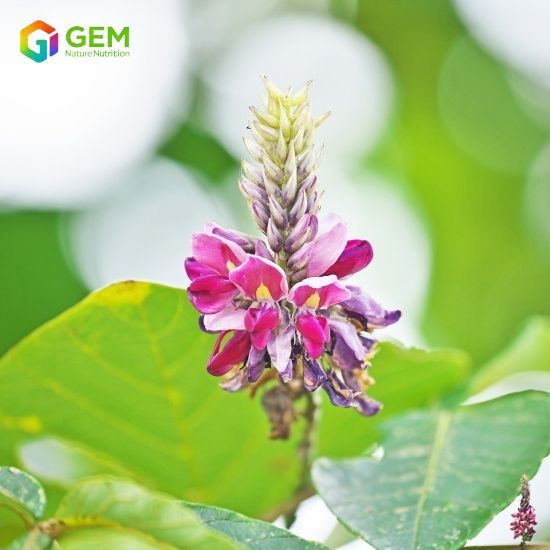
Pueraria Flower Extract
Pueraria Flower Extract bulk ingredient for B2B formulation sourcing. Request a specification sheet, batch COA, and documentation from GEM.
| 规格名称 | 规格值 |
|---|---|
| Part Used | Pueraria Flower |
| Latin Name | Pueraria lobata (Willd.) Ohwi |
| Mesh | 80mesh |
| Solvents | Water and Ethanol |
| Shelf Life | 24 months |
Pueraria Flower Extract
This guide walks through what Pueraria Flower Extract is, the active compounds that define it, how it is produced under documented quality controls, the specification grades GEM offers, where formulators use it across industries, and the practical details that matter for B2B buying — from private-label and ODM support to sampling, documentation, and regulatory context. Whether you are validating a new SKU or scaling an existing liver-comfort line, the information below is designed to help your procurement and R&D teams make confident, well-sourced decisions.
Pueraria Flower Extract Quick View
Specification:Pueraria Flower Isoflavones 20%; 40% UV
Certificate: ISO9001; Kosher; Halal.
Annual Production Capacity: More than 100 tons
Features: Non-GMO; Non-ETO; Non-Radiation; USP&EP Standard; Allergen (soy, gluten) free.
Application: Pharmaceutical and medicine; Dietary supplement; Basic nutritional ingredients; Food additives and Cosmetics; etc.
Packing: 25kg/drum, 2 layer PE bags inside.
Last updated: June 21, 2026
What Is Pueraria Flower Extract?
Pueraria Flower Extract is derived from the flowering tops of Pueraria lobata, a perennial legume vine native to East Asia that has since naturalized across many temperate regions worldwide. In Chinese herbal tradition the root portion is referred to as gé gēn and the flowering portion as gé huā. Historically, the flower was separately recorded in classical materia medica for its use in supporting the body during periods of alcohol consumption and for general liver-comfort purposes — a tradition that continues to inform modern functional product development.
The plant is the same species that produces the well-known kudzu root, but the flower and the root are not interchangeable. They concentrate different classes of phytochemicals. Pueraria Flower Extract is standardized for total isoflavones (20% or 40% UV), with kakkalide serving as a characteristic marker compound that distinguishes the flower material from root-derived extracts. The extraction workflow parallels that of the root: solvents pull the polar flavonoids from the dried botanical, after which the liquor is concentrated and spray- or vacuum-dried into a free-flowing powder suitable for capsules, tablets, sachets, and beverage systems.
This distinction matters for formulators because the flower and the root deliver different active profiles. Brands developing liver-support or occasion-based wellness formulas frequently choose the flower material specifically for its kakkalide content. The flower and root portions of Pueraria lobata are processed as separate, independently specified raw materials, each with its own compositional fingerprint and quality release criteria.
Botanical Source and Active Compounds
Pueraria lobata (Willd.) Ohwi belongs to the Fabaceae (legume) family. The vine produces clusters of reddish-purple, lightly fragrant flowers that are harvested at peak bloom, quickly dried to lock in both volatile and heat-sensitive compounds, and then milled for extraction. GEM sources raw flower material against strict agronomic and botanical-identity specifications before it ever enters the production line, helping ensure a consistent isoflavone fingerprint from lot to lot.
The bioactive signature of Pueraria lobata flower extract centers on isoflavones and flavone glycosides:
These compounds belong to the broader isoflavone family also found in soy and red clover. For formulators comparing botanical isoflavone sources, our Red Clover Extract and Soy Isoflavones pages provide parallel reference standards and specification grades that can support blend design or competitive benchmarking. Both are confirmed-existing pages within the same natural-plant-extract catalog, which makes them convenient cross-reference points when designing multi-source isoflavone systems.
A practical note on chemistry: isoflavones are structurally related to soy isoflavones, but Pueraria Flower Extract contains no soy protein. This is why the material can be positioned as allergen-free even though it sits within the same broader phytochemical family as soy-derived ingredients. That distinction is important for clean-label and "free-from" marketing claims, which are addressed in more detail in the regulatory section below.
How Pueraria Flower Extract Works — Mode of Action
The commercial interest in kudzu flower extract is driven by the characterized activity of its flavonoids, particularly kakkalide, across liver-related and metabolic pathways. In traditional practice the flower was consumed as a decoction after heavy drinking; modern phytochemical research has begun to map the underlying mechanisms that may explain this long-standing use.
1. Support for normal bile secretion Kakkalide has been observed to promote bile secretion in experimental models. Healthy bile flow supports normal fat digestion and the body's routine elimination of metabolic byproducts, which is one reason the flower has been associated with digestive and liver comfort.
3. Support for healthy liver enzyme levels Several investigations report that kakkalide-containing fractions assist in maintaining normal aminotransferase (ALT/AST) levels within physiological ranges. This is consistent with the flower's traditional positioning around liver comfort and recovery after occasional excess.
Pueraria Flower Extract Product Specification
The table below defines GEM's standard Pueraria Flower Extract specification for the 40% isoflavone grade. Every value is confirmed by the listed test method on each batch, and a full Certificate of Analysis (COA) is issued at release.
| Test Item | Specification | Test Methods |
|---|---|---|
| Appearance | Brown yellow powder | Visual |
| Odor&Taste | Strong&Characteristic | Organoleptic |
| Marker Compound | Isoflavones≥40.0% | UV |
| kakkalide | HPLC | |
| Identification | Must positive | TLC |
| Loss on Drying(5h at 105℃) | ≤ 5.0% | GB 5009.3 |
| Ash(3h at 600℃) | ≤ 5.0% | GB 5009.4 |
| Pesticide | 666≤0.1mg/kg | GB/T 5009.19-2008 |
| DDT≤0.1mg/kg | GB/T 5009.19-2008 | |
| Total Heavy Metals | ≤10.0mg/kg | GB 5009.74-2014 |
| Lead | ≤1.5mg/kg | GB 5009.12-2017 |
| Arsenic | ≤1.0mg/kg | GB 5009.11-2014 |
| Mercury | ≤0.3mg/kg | GB 5009.17-2014 |
| Cadmium | ≤0.3mg/kg | GB 5009.123-2014 |
| Total Plate Count | ≤1000CFU/g | GB 4789.2-2010 |
| Yeasts&Molds | ≤100CFU/g | GB 4789.15-2016 |
| Salmonella | Negative | GB 4789.4-2016 |
| E-Coli | Negative | GB/T4789.3-2003 |
| Staphylococcus aureus | Negative | GB 4789.10-2016 |
Specification grades available: Pueraria Flower Isoflavones 20% and 40% UV. The 40% grade shown above is specified with kakkalide as the HPLC-identified marker compound; the 20% grade follows the same contaminant and microbial limits with a lower total-isoflavone target. Custom specifications can be discussed for qualified commercial accounts.
Production Process and Quality Control
GEM's manufacturing route for Pueraria Flower Extract follows a controlled, vertically managed workflow designed to protect both botanical identity and finished-powder purity:
Raw material selecting – Pretreatment – Concentration – Drying and crushing – Testing and packing.
Each stage is backed by documented controls that protect both identity and purity:
- Raw material selecting — Only dried Pueraria lobata flowers that pass botanical identity (TLC), moisture, and foreign-matter checks are accepted into the process.
- Pretreatment — Cleaning, cutting, and milling prepare the biomass for efficient, uniform extraction.
- Concentration — The extract liquor is concentrated under reduced temperature to protect heat-sensitive flavonoids from degradation.
- Drying and crushing — Spray or vacuum drying yields a fine powder that is milled to a consistent particle size for reliable blending.
- Testing and packing — Every batch is released only after full specification testing (see the table above), then packed in 25 kg drums with double PE liners.
Our facility operates under ISO9001 with USP&EP-aligned internal standards, and the material carries Kosher and Halal certification for broad global market access. With more than 100 tons of annual production capacity, GEM can support both pilot-scale sampling and high-volume recurring supply for international B2B customers. The reduced-temperature concentration step is central to preserving kakkalide and the broader flavone glycoside profile, since these compounds are sensitive to prolonged heat exposure during processing.
Formulation Tips for Product Developers
To get the most out of Pueraria Flower Extract in finished goods, keep the following practical points in mind during product design:
Because the powder is best dispersed in warm aqueous systems, beverage developers often pre-slurry the extract before adding it to the main tank, which minimizes clumping and improves uniformity across the finished batch. For dry formats such as stick packs and tablets, a granulation or pre-blend step with a free-flowing carrier is recommended to keep the active evenly distributed.
Market and Regulatory Context
Demand for botanical liver-support and occasion-wellness ingredients has grown steadily as consumers seek plant-based alternatives to synthetic options. Kudzu has a long record of food use in Asia — including the flower in teas — which supports its familiarity as a dietary ingredient. At the same time, kudzu flower extract remains a more specialized, lower-volume material than kudzu root, giving early-adopter brands a point of differentiation in crowded categories.
On the label side, our material is Non-GMO, Non-ETO, and Non-Radiation, and it is produced to USP&EP standards. It is also free from soy and gluten allergens — an important clarification, since the isoflavone chemistry is structurally related to soy isoflavones but the product contains no soy protein. This clean-label profile supports vegan, allergen-free, and "free-from" marketing claims where substantiated by the buyer's local regulations.
Pueraria Flower Extract vs. Pueraria Root Extract
Although both come from Pueraria lobata, the flower and root serve different formulation roles. Understanding the contrast helps procurement and R&D teams select the right grade:
Many brands stock both: the root extract for broad-isoflavone and circulation-oriented products, and the flower extract where kakkalide-specific positioning is desired. The two materials are produced as independent, separately specified raw materials, each with its own COA and release criteria, so they can be sourced and qualified on separate timelines.
Private Label & ODM Guidance
Pueraria Flower Extract is rarely the only ingredient in a finished product, and GEM supports brand owners who want more than a raw material. Our private-label and ODM services cover custom blends, particle-size adjustment for improved flow and dissolution, and tailored isoflavone ratios matched to your sensory and cost targets.
Because the ingredient is frequently combined with other botanicals, sourcing from a single qualified supplier reduces paperwork, lead time, and quality risk across your formula. GEM's natural plant extract portfolio spans Red Clover Extract, Soy Isoflavones, Red Ginseng Extract, Reishi Mushroom Extract, and Lion's Mane Mushroom Extract, enabling combined ODM projects from one manufacturer with consolidated certificates and documentation.
Typical ODM engagement steps: (1) share your target application, isoflavone grade, and budget; (2) GEM proposes a grade or blend with samples; (3) you pilot and refine; (4) we lock the spec, certificates, and packing for recurring production. Available certificates include ISO9001, Kosher, and Halal, with COA and MSDS supplied per commercial batch.
B2B Buying and MOQ Guidance
GEM supplies Pueraria Flower Extract as a B2B raw material with commercial terms designed for scale:
- Standard packing — 25 kg per drum, with two layers of PE bags inside for moisture protection during transit and storage.
- Grades available — Pueraria Flower Isoflavones 20% and 40% UV, allowing you to match cost and potency to the target SKU.
- Production capacity — More than 100 tons of annual capacity supports stable, repeatable supply for growing brands.
- Sampling and MOQ — We support formula-validation sampling ahead of volume commitment; minimum order quantities and lead times are confirmed at quotation based on grade and destination.
- Documentation — Specification Sheet, COA, and MSDS are provided with commercial shipments, alongside ISO9001, Kosher, and Halal certificates.
- Customization — Particle size, blending, and private-label options can be discussed for qualified accounts.
To request a quote, sample, or full dossier, contact the GEM sales team with your target grade, estimated annual volume, and destination market so we can align specifications and certificates to your needs.
Frequently Asked Questions
1. What is the difference between pueraria (kudzu) root extract and flower extract?
One is extracted from the whole root of Pueraria lobata, while the other is extracted from the flowers. They contain different active ingredients and are therefore used for different formulations. The flower material is characterized by kakkalide, whereas the root material is led by puerarin. Each is produced as a separate, independently specified raw material with its own compositional fingerprint.
2. Which one is more popular in the market?
The pueraria (kudzu) root extract is much more popular and has a larger established market volume. The flower extract remains a more specialized ingredient, which can be an advantage for brands seeking a differentiated botanical story in crowded liver-support and occasion-wellness categories.
4. What are the main active compounds in Pueraria Flower Extract?
The profile centers on isoflavones and flavone glycosides, with kakkalide as the signature marker compound of the flower. Other notable constituents include tectorigenin, tectoridin, irisolidone, and smaller amounts of puerarin, daidzin, daidzein, genistin, and genistein. The isoflavone chemistry is structurally related to soy isoflavones, but the product contains no soy protein.
6. What specification grades does GEM offer for Pueraria Flower Extract?
GEM supplies the material at two standardized isoflavone levels: Pueraria Flower Isoflavones 20% and 40% UV. The 40% grade is specified with kakkalide as the HPLC-identified marker compound. Custom specifications can be discussed for qualified commercial accounts.
7. Is Pueraria Flower Extract non-GMO and allergen free?
Yes. Our material is Non-GMO, Non-ETO, and Non-Radiation, and it is free from soy and gluten allergens. Although the isoflavone chemistry is related to soy isoflavones, the product contains no soy protein, which supports allergen-free and vegan labeling where substantiated by the buyer's local regulations.
8. What quality certificates does GEM provide?
The material is covered by ISO9001, Kosher, and Halal certificates. Production follows USP&EP-aligned internal standards. Additional documents such as the Specification Sheet, COA, and MSDS are provided with commercial orders.
9. How is Pueraria Flower Extract packed, and what is the shelf life?
Standard packing is 25 kg per drum with two layers of PE bags inside. Store in a cool, dry, sealed container away from direct light and moisture. Under recommended conditions the material maintains its specification across its intended shelf life; confirm the exact shelf-life window with your quotation documents.
10. Can Pueraria Flower Extract be combined with other botanicals?
Yes. It is frequently co-formulated with botanicals such as milk thistle for liver-support products, or with artichoke, dandelion, and B-vitamins in beverage applications. Blending partners should be selected to complement the extract's flavor and stability profile, and co-ingredients should be qualified under the same quality system where possible.
11. What documents are available for B2B orders?
We provide a Specification Sheet, Certificate of Analysis (COA), and MSDS upon request, plus ISO9001, Kosher, and Halal certificates for qualified commercial orders. These documents support your internal quality release and regulatory submission processes.
12. How should I formulate with Pueraria Flower Extract for the first time?
Start by selecting the isoflavone grade that matches your label claim, then pre-blend the powder with a carrier for dry formats or disperse it in warm water for beverages. Protect the finished goods from light and moisture, and validate taste-masking where consumer palatability matters. Our technical team can advise on particle size and blend compatibility during sampling.
Further Reading
- Red Clover Extract — another botanical source of isoflavones for blend design
- Soy Isoflavones — parallel reference on isoflavone chemistry and grades
- Red Ginseng Extract — context on traditional East Asian botanicals
- The Magical Red Clover Extract — isoflavone ingredient profile article
- Chinese Magic Herb: Ginseng — traditional East Asian botanical context